

The US is getting bogged down in a disaster in Iran right now, and despite Trump’s many lies, the war doesn’t seem to end anytime soon.
Naturally, people start to ask: if a military invasion of Taiwan is what China has long planned for, isn’t this the perfect timing for it? Why would China waste this golden opportunity?
In this essay, I will explain to you why this won’t happen.
I understand Taiwan is an emotionally charged topic for many people. Some of you will not like my conclusions. So first, I want to clarify my role here.
I am not here to pass normative judgments about which side is right or wrong. My role is that of an analyst. I see many people, some of whom are my clients and many of whom have stakes on the table, are concerned about the situation in Taiwan right now. They deserve clarity on this issue and a level-headed analysis with some predictive value. That’s what I try to provide here.
As early as 3 weeks ago, I predicted the war in Iran was not going to end soon. And now I want to share with you this other high-conviction assessment of mine.
Recap of Part 1
If you have already read Part 1, you can skip this part. If you haven’t, here is a quick recap.
In Part 1, I laid out two fundamentally different perceptions of Beijing's core policy formula on Taiwan, namely, “We strive for peaceful reunification, but we do not promise to give up use of force.”
From an American (and, to a large extent, Western) perspective, the main focus of this formula is the “use of force”. “Reunification” ranks second, but China’s expansion won’t limit itself there. It’s just the first step of a global expansionary ambition. “Peace” is just a cover-up phrase.
From China’s perspective, though, the order of emphasis is entirely different. The first and foremost thing is “reunification”, a daily obsession of the People’s Republic of China since its founding. (It was also the daily obsession of Taiwan before Chiang Kai-shek passed away.) After it, “peace” ranks second. A peaceful reunification is much preferred to war. I concluded that the US far underestimates China’s obsession with reunification, as well as its desire for a peaceful reunification.
To set the broader context, I took some time to explain why there was this obsession. My explanation is from a pragmatic perspective. The core argument is that Taiwan is at the heart of the PRC’s founding myth, that without it the country will fall apart, and that the Party itself will lose its mandate to rule. Therefore, the whole Taiwan Question is existential for China, not just a piece of land that Beijing can bargain away for something else.
Whatever you believe about which side is right in this great conundrum, this “existentiality” of Taiwan from the perspective of Beijing sits there like a rock. Any serious analyst of the situation can’t look away from it.
Again, please go to Part 1 for a more fleshed-out argument.
Peaceful reunification: the pull factors
So now we understand that Taiwan is existential for China, shouldn’t China jump on this great opportunity to attack Taiwan and finish the deed once and for all?
No.
If there is only one key conclusion you could take away from this essay, it’s this:
China, ultimately, needs a peaceful reunification.
Peaceful reunification is both preferred and increasingly likely.
Time is on China’s side.
There are at least three reasons supporting this conclusion: there is an economic one, a cultural and political one, and a final part about Xi’s own vision for his legacy.
The economic argument is obvious. A seaborne invasion of a big, mountainous island armed like a porcupine is extremely difficult. If China succeeds quickly, international sanctions and disruptions to external trade links will cause significant pain to China’s economy. If China can’t deliver a quick win, it will also become an economic disaster that could potentially dial back all the progress we have made since the reform and opening-up era. Inverteum Capital covered this topic quite comprehensively in their essay Why China Won’t Invade Taiwan.
The cultural reason is more squishy, and it’s difficult to explain it well to people who have never had real experience dealing with the Chinese. But I will try.
You may well remember that in my rebuttal to Noah Smith, I laid out my key observation: China is not an “insecure-expansionist” power like Nazi Germany, Imperial Japan, or the Soviet Union, so war and aggression have no popularity here as solutions to big problems. I also explored why history and geography have shaped China into a generally peace-loving culture.
A few weeks ago, a TV drama called Swords into Plowshares (太平年, literally “The Peaceful Years”) became an unlikely success in China. The show covered a historical period in China that even most Chinese people knew little about: The Five Dynasties and Ten Kingdoms (907–979 AD), a chaotic 7 decades between the fall of the Tang Dynasty and the rise of the Song Dynasty.
It was a dark period marked by great political turmoil, murders, famine, and even cannibalism1, when might was right, when emperors died like flies, and when dynasties rose and fell every few years. It was also a period when rules and order broke down completely, and whoever controlled the armies claimed the throne.
In short, it was about a historical period that stands in total contrast to everything modern-day China represents.
The show began in the middle of this historical period and ended with its final chapter: a famous moment when the Kingdom of Wu Yue, which mostly occupied present-day Zhejiang, Shanghai, and southern Jiangsu, surrendered its territories to the Song Dynasty, and the country was finally reunified, peacefully.
To be sure, there is quite a big dose of pseudo-history in this show, too. The show made it seem as if surrendering to central authorities for the sake of national unity had always been the King of Wu Yue's eventual goal. The actual historical truth, however, involved far more coercion than was portrayed.
But still, the overall contours of history were respected, and it was true that no lives were lost when the Song Emperor put today’s Zhejiang and Shanghai under his fold.
The political analogy in this show is subtle but hard to escape for most Chinese viewers. One especially interesting scene was towards the end of the show, when the Song emperor discussed the strategy with his generals.
He asked General A: “How many men do you think you need to conquer Wu Yue?”
General A: “400,000 men.” (This is a huge number in that era.)
He then asked General B, who is more junior to General A: “What do you think?”
General B: “I need 300,000 men.”
Emperor: “Oh, so General B is somehow more capable than General A?”
General A: “300,000 men is possible, but it will be a war that will leave the land of Wu Yue in total ruins.”
The emperor fell silent with visible pains in his face.
You see, what’s interesting about a Chinese TV drama that you can’t find in American dramas is that this one not only has no problem of using an epic peace, not an epic battle, as a way to wrap up a big show, but also takes the pains to show you the deliberations about the lengths those characters go to in order to avoid violence.
This show is just one of the many soft reflections of China's national character. To add more hard data to this, I want to cite a very good report from the China Pulse survey by Emory University, the Carter Center, and The Monitor: (Emphasis mine)
In the July-August 2025 wave of this survey, a small majority (51%) of the Chinese public agreed Taiwan should not be unified by military force under any circumstances (29% disagreed). In the October-January wave, there was no majority opinion (38% agree vs. 45% disagree).
Should Taiwan declare de jure independence from the mainland, the Chinese public supports limited military operations on offshore islands (81%) and economic sanctions (62%) as a response over a full-scale military attack (32%).
Twice as many Chinese people agree the use of military force will only make the Taiwan issue worse (50%) than disagree (24%).
These results are similar to my own reading of the situation. An unprovoked war over the Strait of Taiwan will be deeply unpopular.
Ironically, while an American president can start an unpopular war as he likes, China’s top leader needs to read the room much more carefully before launching one. This is because China’s system is delicate, even brittle, and the deep internal imbalances caused by external military adventures have led the country to implode again and again.
Peaceful reunification: the push factor
While these economic, cultural, and political factors serve as the great “pull effect”, they can still be unsatisfactory for skeptics. After all, many of you still hold the view that it’s all up to Xi Jinping himself.
If Xi Dada is determined to take down Taiwan one way or another, for a man who has sufficiently proven his resolve and willpower to the world, he will find ways to bypass all these restraints. And if that’s true, the best moment to take action is indeed right now. With just one signature from him, the People’s Liberation Army, an organization largely insulated from the rest of the population, will jump on this opportunity to sail across the narrow strait in one swoop.
Except, there is also a strong push effect here, a big incentive for him not to plunge into a war.
It’s about what he sees as his own legacy.
I think by now, very few people disagree that Xi is someone with a keen sense of mission, whether you like his mission or not. So what’s his mission? I can’t guarantee I know everything about this, because I can only gather information from public sources about his past words and deeds.
What I am very certain of is that his mission is deeply intertwined with this country's cultural impulses. In other words, it’s impossible for him to set his life’s mission for the Chinese nation as something entirely alien to what the Chinese nation considers to be right. (This statement is actually tautologically correct.)
If China is a country that has chosen to disdain violence, how would a Chinese leader want to be remembered? It will not be hard to conclude that their loftiest dream is to be remembered as someone who oversees unity, prosperity, and peace.
Here, the cultural factor is no longer just a pull factor, but also a push factor, hard-wired into the decision-making algorithms of Chinese leaders.
In such a context, a peaceful reunification carries far more prestige than a military invasion can ever achieve, and will go down in China’s 3,000-year history as one of the greatest feats of all time.
Honestly, which Chinese leader can refuse this enticing possibility?
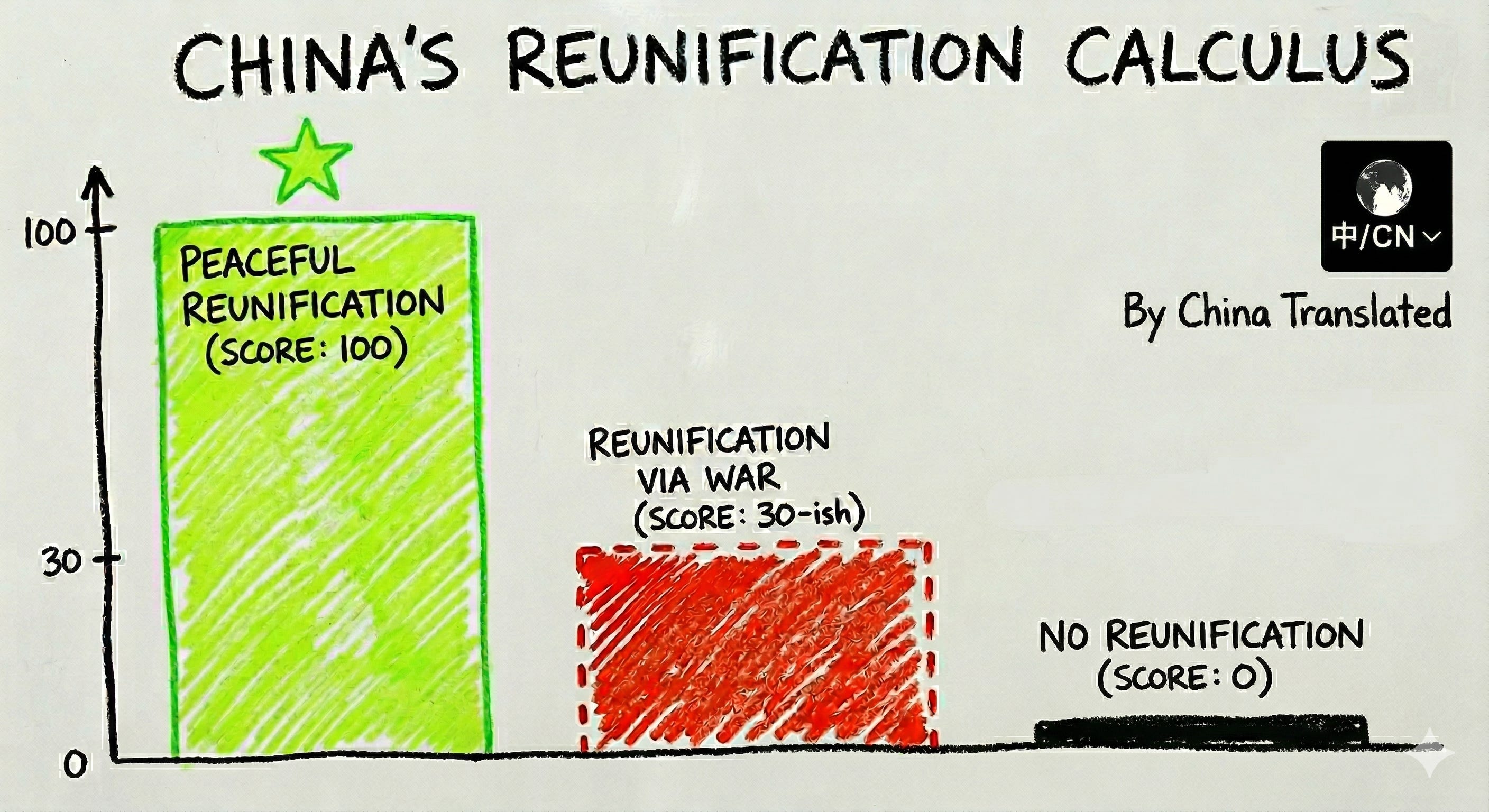
To put it in some pseudo-quantitative way, imagine there are 3 outcomes for Xi. One is a peaceful reunification, one is a reunification through bloodshed, and the last one is no reunification.
A “no reunification” is 0. A peaceful reunification is a 100. A reunification, albeit through war, is probably only at the 20-30 mark. It’s better than “no reunification”, but it’s a huge downgrade from the other option. It’s not an easy choice to make, and will always be the painful last-resort choice
So why is PLA preparing for combat?
If the argument is that China prefers peace, how do we explain the frantic pace of its military modernization? From the rapid commissioning of naval vessels to the expansion of its nuclear arsenal and Xi’s frequent, televised orders for the PLA to be “ready to fight and win”, the optics suggest a nation on a war footing.
Analysts often point to the “Davidson Window”, the 2021 assessment by US Admiral Phil Davidson that China might attempt a military takeover of Taiwan by 2027, as a definitive invasion deadline.
No, I am only playing with you here. Davidson actually only said that China would be combat-ready by 2027, but many people already jumped to the conclusion that it’s a countdown to war. (The Wall Street Journal even had a whole report about this misconception.)
There is a massive strategic gulf between having the capability to win a war and having the intent to start one. Sun Tzu’s The Art of War famously argues that “the subjection of the enemy’s army without fighting is the pinnacle of excellence.” To achieve a peaceful reunification, Beijing must first eliminate the “military option” for its adversaries.
A deadline for combat readiness is thus a prerequisite for peace. It is only when the PLA can demonstrate a 100% certainty of victory, and a corresponding 100% certainty of defeat for any intervening force, that war can be avoided. By building a military that makes the cost of resistance unthinkable, Beijing believes it can finally bring the modern-day “Kingdom of Wu Yue” to the table without firing a single shot.
In fact, if war were the final goal, then hiding strength and biding one's time rather than showcasing daily military progress would be the better strategy for winning. After all, subterfuge is the key to military success. Eisenhower never told Hitler his forces would land in Normandy. Putin lied for many months before the war that he would not attack Ukraine.
Does Xi have to finish the job within his lifetime?
It is true that early in his tenure, Xi Jinping famously stated that the Taiwan question “cannot be passed on from generation to generation.” Many observers have latched onto this phrase as a ticking clock, interpreting it as a personal vow that he must achieve reunification before he leaves office or passes away.
However, this is a narrow and likely incorrect reading of his intent. While Xi certainly wants to move toward a solution, there is a massive difference between “not waiting forever” and “forcing a conclusion at any cost.”
If the price of reunification is the wreckage of the Chinese economy and the derailment of China’s “Great Rejuvenation”, I highly doubt Xi would bang his head against that wall to achieve it. As former top CIA China analyst Chris Johnson argued in his essay, the idea that Xi is driven by a desperate “legacy obsession” to seize Taiwan regardless of the risks lacks firm evidence. For a leader who views himself as the steward of China’s return to global preeminence, a reckless gamble that leaves the nation wide open to a high risk of self-implosion is the ultimate bitter pill I doubt he will ever want to swallow.
Interestingly, my own high-conviction assessment of this timing also closely aligns with the recent consensus within the U.S. intelligence community. In the 2026 Annual Threat Assessment, the US ODNI concluded that Beijing is not currently planning a military invasion. While I often find myself at odds with Washington’s broader narratives, on this specific point of tactical restraint, the analysts at Langley and I are reading the same room.
Xi is a man of resolve, but he is also a pragmatic calculator of risk. To him, “not passing the problem down” means building the overwhelming strength that makes reunification inevitable, not launching a desperate crusade to meet an imaginary deadline.
How and when?
To understand how this ends, we must first accept an uncomfortable, fundamental truth: the “Taiwan Question” has never been a bilateral issue between Beijing and Taipei. It is, and always has been, a function of the U.S.-China relationship.
Historically, the US has been the primary variable in this equation. In the 1950s, when the US all but gave up on Chiang Kai-shek, the Korean War broke out, leading Truman to save the KMT’s Taiwan from certain defeat. In the 1990s, U.S. carrier groups again intervened to maintain the status quo.
But the reverse logic is also simple: if it becomes clear that the United States is no longer willing or able to defend the island, the question will be solved almost instantly.
Will Washington defend Taiwan? There are both push and pull factors for the US, too.
The current disaster in Iran serves as a sobering data point for Washington’s “pull factors.” If the U.S. military is struggling to secure the Strait of Hormuz against a regional power like Iran, the prospect of defending Taiwan against a China that is a hundred times more powerful than the IRGC becomes strategically daunting.
However, there is also a significant “push factor” keeping the U.S. tethered to Taiwan: semiconductors. In a recent poll of my American subscribers, 68% cited TSMC and chip supply as their No. 1 concern regarding Taiwan, accounting for more than half of their “Taiwan mind share”. This is understandable. For NASDAQ and the broader U.S. economy, Taiwan is essentially a single point of failure.
Interestingly, this creates a profound asymmetry of needs. If I were to poll the Chinese public, I suspect chips would occupy less than 5% of their own “Taiwan mind share”. As I explained in Part 1, to Beijing, Taiwan is an existential matter of national sovereignty; to Washington, however, it is mostly a matter of supply chain security.
This asymmetry is exactly where the opening for peace lies.
In any negotiation, when one party wants “A” (sovereignty) and the other wants “B” (uninterrupted silicon), there is room for a bargain. The critical deadline for peaceful reunification, therefore, is not a military one, but an industrial one: the maturity of domestic U.S. semiconductor foundries.
Once the CHIPS Act projects reach full capacity and the U.S. feels it has achieved semiconductor independence, the strategic necessity of defending Taiwan evaporates. At that point, for the US, the liability of a potential war will outweigh the benefit of the island’s autonomy, and we will see the gears of negotiation begin to turn.
This also explains why Beijing’s reaction to Japanese Prime Minister Takaichi’s recent comments was so fierce. Some called it irrational, but Beijing was actually dead rational. By suggesting that a Taiwan contingency is an “existential crisis” for Japan, Takaichi threatens to transform a manageable U.S.-China negotiation into a much more volatile China-Japan confrontation. For Beijing, involving Japan, a country toward which the Chinese public holds deep historical grievances (unlike the attitude towards the US), raises the stakes from a cold strategic bargain to a hot emotional conflict. It puts the “30-score” scenario of a destructive war back on the table.
Make no mistake: war is not a zero-percent chance. Conflict will occur if China ever feels truly vulnerable, if Beijing concludes that all peaceful avenues are closed, and if a painful, “low-score” reunification is the only way to prevent the total collapse of its own founding myth.
But as long as the path to a high-prestige, peaceful settlement remains open, time remains on China’s side.
[85% of this article is written with human hands, 15% are written by AI after I dictate the outline]
It’s probably the only Chinese TV show that actually showed cannibalism on screen
Forgot to add: If the war in Iran drags on for not just weeks but months and China is still not taking any military action, I don't think any serious people will ask the question "will China attack Taiwan". So I figure I have to write this piece asap, otherwise it will lose relevance.
Excellent piece.
May I just add one additional point that might help: holding a territory taken by force is expensive and morally corrosive, especially in this day and age.
It's very odd to me that people think of colonialism and don't take into account the force multiplier that the monopoly over firearms gave to the Western occupiers. When one side is armed with swords (mandating close action combat) and the other side with firearms, you could kill vast numbers of people at a distance safely without endangering your own troops. When troops have to die, it becomes much harder.
With the spread of firearms technology, the cost of maintaining an occupying army increased. You needed more troops, those troops had to be armed and they would be taking greater risks of being killed. You could keep increasing the numbers and weapons, but that becomes an ever greater drain on your treasure to the extent that the amount you can extract from the territory becomes less than the amount spent on maintaining it. When WWII drained the treasuries of the occupying nations so that this expense could no longer be kept up, colonisation also ended. Not because the colonisers were suddenly stricken by a bad bout of morals but because they couldn't afford the cost anymore. And still they had to be forced out with much blood and treasure lost on both sides.
As events in the Middle East and Middle Asia show, you can't bomb a people into submission, and attempts to hold it come at a huge cost. China bombing the province of Taiwan will be a Phyrric victory at best.
The only real way to hold a territory that has been forcibly taken over is to remove the current inhabitants (either forced transfer or genocide, a la Israel) and move in your own people. See what the British did to Scotland and Northern Ireland. And then in this day and age you have to monitor the inhabitants you remove to ensure that they don't set up cells to conduct terrorist attacks. This reinforces the sense of the people of the colony that they are a separate people from your own. It also creates moral corrosion of your own people--see what has happened to the character of the West, twisting itself into pretzels justifying their cruel past or trying to pretend it still isn't happening.
For those who would point to Germany and Japan post World War II, I would point out that resistance had already been bled dry via the wars and, for the elites of those countries, the threat of communism taking their wealth was a mind concentrator: better to side with the Americans who were willing to make you wealthy so that they had a market to sell to than risk your country falling to the communists who would distribute your wealth to the "rabid masses". That dynamic no longer exists.
The Chinese get this. They get that the only way to hold Taiwan and keep Taiwan is for the Taiwanese to voluntarily agree to come back.
People who think only in terms of the short term use of force have been educated by the colonial "adventures" when the massive force multiplier and monopoly over firearms allowed real mass slaughter of the colonised while the colonisers could sip their gin tonics in the safety of their "whites only" clubs, wrapping themselves in the chilly comfort of their hypocrisies. Those days are long gone.