

The past 2 weeks have marked perhaps the lowest point in Sino-Japanese relations since WWII.
Yes, we had previous episodes of bad blood between the two countries, from the 2012/2013 Diaoyu/Senkaku dispute to the more recent nuclear waste controversy. But none of these past incidents was as politically poisonous as Takaichi’s comment on Nov. 7 regarding Taiwan:
If warships are used accompanied by the exercise of military force, then however you look at it, it could be a situation posing an survival-threatening threat to the country (Japan).
What happens afterwards has been intense information warfare from all sides. On China’s side, the Chinese consul at Osaka shocked social media with his “beheading” comment. I don’t think letting crude comments take the center stage is wise here, as it easily shifts too much of the attention towards this patronizing attitude of how overly “emotional” or “immature” China seems to be. The ensuing noise makes many people unable and unwilling to ask the simple question: just why exactly is anything happening to Taiwan a “survival-threatening” event for Japan again?
It’s a bit absurd if you consider the fact that this would imply that the Republic of China government in Taipei and Japan are military allies, and that Taiwan falls under Japan’s protection, or at least sphere of influence. It’s as if the Empire of Japan and Taiwan’s status as its overseas colony never ceased to exist.
It’s absurd also because even the US has never said this kind of thing. Never has the US officially claimed or guaranteed that it would ally with Taiwan should the war happen. But Japan has. You heard it right: Japan, represented by Takaichi, is the first one among all countries to explicitly state that a military action in Taiwan would trigger its own military response.
At least 2 reasons immediately come into my mind for China’s fierce protests against this, and it will be impossible for China to off-ramp until Takaichi, a long-term China hawk, takes down her comments.
First of all, for an issue as “core” as Taiwan, if China sits there and does nothing about the first country to speak out about its intention to engage militarily in Taiwan, there is a risk of creating a domino effect. If more countries join this, China will be cornered into some very dangerous action regarding Taiwan.
This is why I found no merit in the kind of comment cheering Takaichi’s speech as likely to deter war. To the exact opposite, her comment will only encourage war.
I told Baiguan’s members in our member-exclusive Discord channel recently that if there was a meter in my mind for the risk of war in the next 10 years in Taiwan, it just shot to somewhere at the 50% mark from perhaps the 30% mark instantly after Takaichi’s speech.
Secondly, the fact that this speech comes out of the mouth of the leader of Japan, of all people, becomes an instant spark for nationalistic sentiment in China because of obvious historical reasons. The domestic pressure on Beijing to act forcefully is dialed up to the max. It’s especially sensitive that Taiwan used to be colonized by Japan for half a century between the first and second Sino-Japanese War.
What’s adding more salt to the wounds is that Taiwan is also joining the fray. Just as China re-imposed a ban on Japanese seafood as retaliation, Lai Ching-te, the leader of Taiwan, publicly showcased that he enjoyed Japanese sushi for lunch in an obvious dig at Beijing, adding to the impression of the “soft alliance” that Takaichi is implying and that Beijing is specifically attacking.
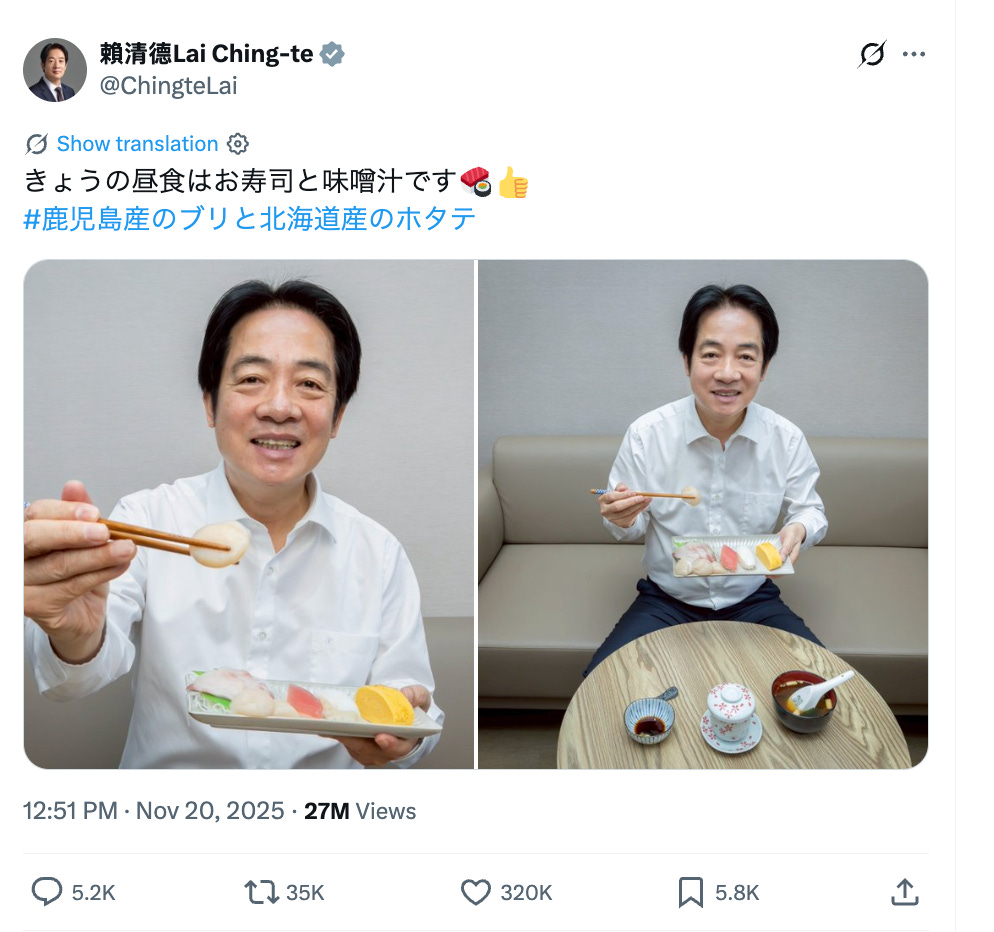
I don’t think these are serious people. To them, the possibility of a war seems to be a matter of fun, and that the battle of memes is all there is. Like children, they can just poke their stick here and there, thinking these can mean anything.
Or perhaps neither Takaichi nor Lai is stupid. All of these dramas happen in a broader context that few people mention in the heat of meme battles: what the US is going to do.
2025 marks a crucial watershed moment when China reaches peer status with the US. As the US and China negotiate terms for a detente and the US becomes increasingly isolationist, the risk of being sidelined is acutely palpable in both Tokyo and Taipei. The strategic gambit by Takaichi-Lai is perhaps to create enough noise to remind the US of its perceived obligations in East Asia and to drag the US back in.
It’s a calculated, but highly risky move. It’s getting riskier by the day as the Trump Administration stays notably silent about the whole thing amid all the rancor. Trump, Rubio, Vance - none of them spoke a word.
This radio silence would only add to Takaichi and Lai’s suspicion and may push them to double down on their gambit, which would only lead China to escalate further.
Brace for more troubles ahead.
It is possible that the new PM comments are a concern for the nearby Japanese islands and the potential impact of warships and blockade. It may also be a public signal to be clear that her position on reunification is not one of support. There remain countries and individuals who do not see reunification as inevitable, including many citizens of Taiwan. I think the danger of direct comments or challenging comments is the decision by any of the sides to use the statements as a reason to begin hostilities. I do not think statements alone, without military preparations and positions, are reason enough to begin hostile actions unless one of the parties is seeking an excuse to begin. Perhaps JP and TW are calling the bluff, and perhaps they will regret the call.