

My grandpa passed away more than 4 years ago.
He was not a famous person, but he was remembered by friends and relatives for many intellectual legends.
Born in rural Zhejiang in the 1930s, he was soon found to be a child prodigy. One of his uncles sponsored his education in the county high school. Yet, unfortunately, he had to terminate his studies because his school was bombed in the war.
Not a quitter, going back to the same rural town that our ancestors had lived in for over a thousand years, he taught himself the whole curriculum and became a teacher. What’s more amazing is that he taught math, Chinese literature, and Chinese history to students from grade 1 all the way to high school seniors.
I never understood how he managed to do that. It’s as if he were already an AI-enhanced superhuman, except that ChatGPT happened a year after he left our world.
And as one of the extremely few members of his generation in rural China who knew how to use a computer, one of his daily routines in the last decade of his life was spending hours a day playing Sudoku online. It was said that his anonymous account was often ranked highly in some global leaderboard for that game.
We often wonder what kind of achievement grandpa could have made had he been born in a different era, and his studies were not interrupted by wars, and he went on to study in Hangzhou, in Beijing, or perhaps in the United States, just like folks like Yang Chen-Ning of his era.
Grandpa was not a talkative person. When he spoke, he spoke with a thick Shaoxing-style Wu accent, so that I could hardly understand him. Furthermore, living mostly with my parents in Nanjing, I didn’t spend much quality time with him as I grew up. All of these made him this legend-type of person in my memory, and sadly made him more of a mystery even for me.
One thing I do know about him is that he dedicated his twilight years to revising a book of genealogy of our clan. I knew from my parents that it was a huge endeavor. But it was only until the last few days, during the Spring Festival holiday, when I finally opened its pages that I had an understanding of its magnitude.
The book, as revised by a committee headed by my grandpa, spanned 38 generations all the way to the year 779, in the middle of the Tang Dynasty. This revision, the 15th revision in history, was nothing short of a miracle.
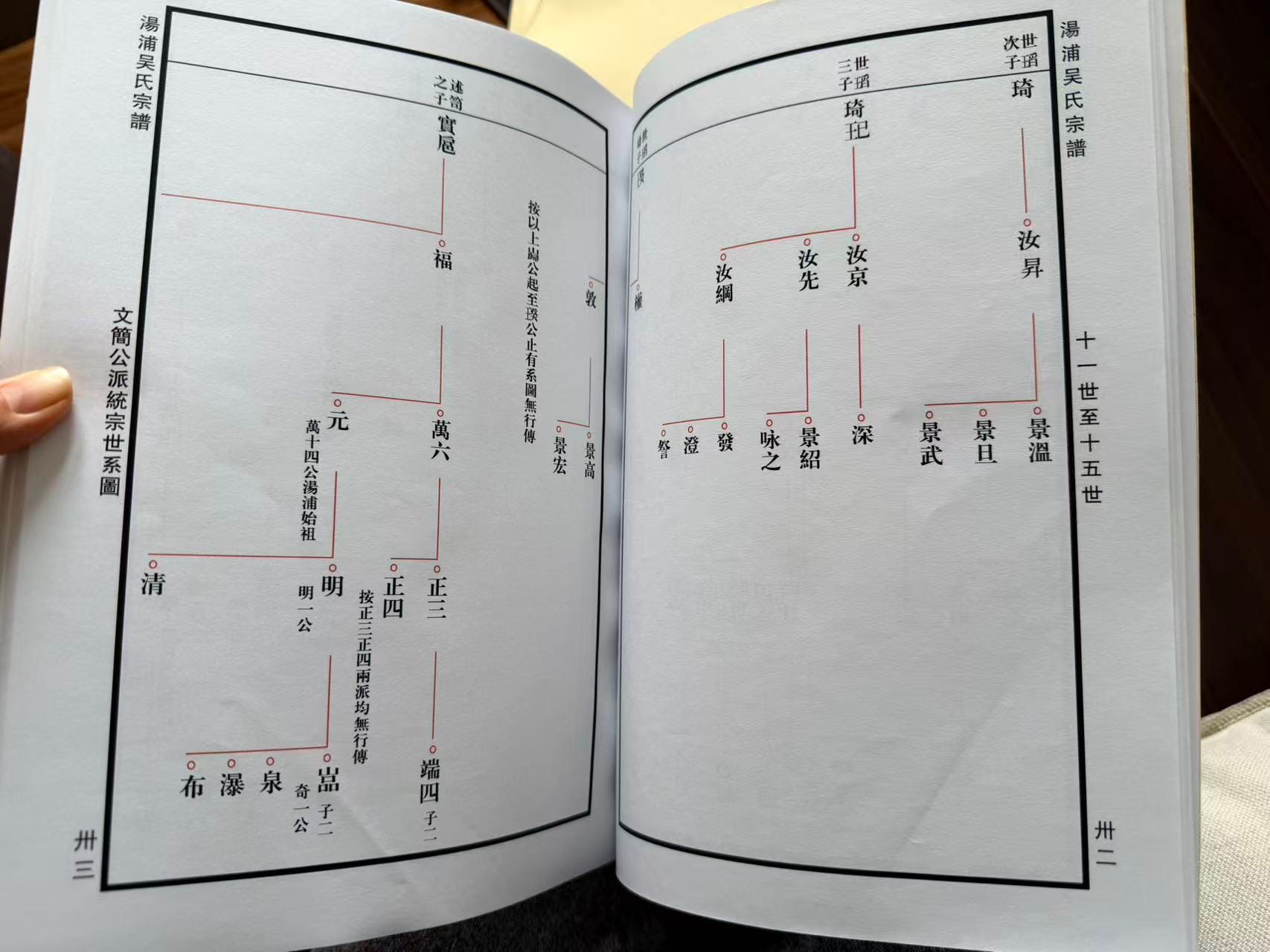
I won’t bore you with the actual family tree. But in this post, I have translated 4 interesting articles that I found in this treasure trove.
The first one is the preface written by my grandpa, detailing how the original Book was destroyed by the Cultural Revolution, grandpa’s personal journey about how the revision came about, and what many challenges they faced during the endeavor.
The second one is about how a pivotal 1947 edition was re-discovered, miraculously and literally through a dream, and the third one recounts how this same edition was salvaged from certain destruction during the Cultural Revolution. It’s all but certain that if they hadn’t found this 1947 edition, my grandpa would not have been able to finish this project before he passed away.
The last one was one of the more ancient accounts written and added to the book by ancestors. They read like a history book, written in classical Chinese. This particular one that I referenced here recounted how their little town suffered during the horrendous Taiping Rebellion, the Chinese civil war in the 1850s and 60s that claimed the lives of millions.
The motivation for this translation is two-fold.
First, I want to showcase to you this side of China, about what many of our older generation treasure at heart, a glimpse into their spiritual world.
Reading about how those lively characters - my grandpa who vowed that he would dedicate his life to this project, Mr. Chuanjia who kneeled before the long-lost 1947 edition and wept with joy - reminds me that, contrary to my own perception, many Chinese people are also faithful. It’s just that the exact nature of faith may be different from other versions.
The second motivation, of course, is to remember my own late grandpa. The private, silent, reclusive old genius who taught the child me math and Chinese history lessons. The eternal stranger that I would never be able to direct my questions to.
Yet, reading his own words, written in his life’s project for both his ancestors and for posterity, left me with an understanding of him that I never had before: a man of passion who finally found his calling.
I miss you, Grandpa.
And I hope you enjoy his work.
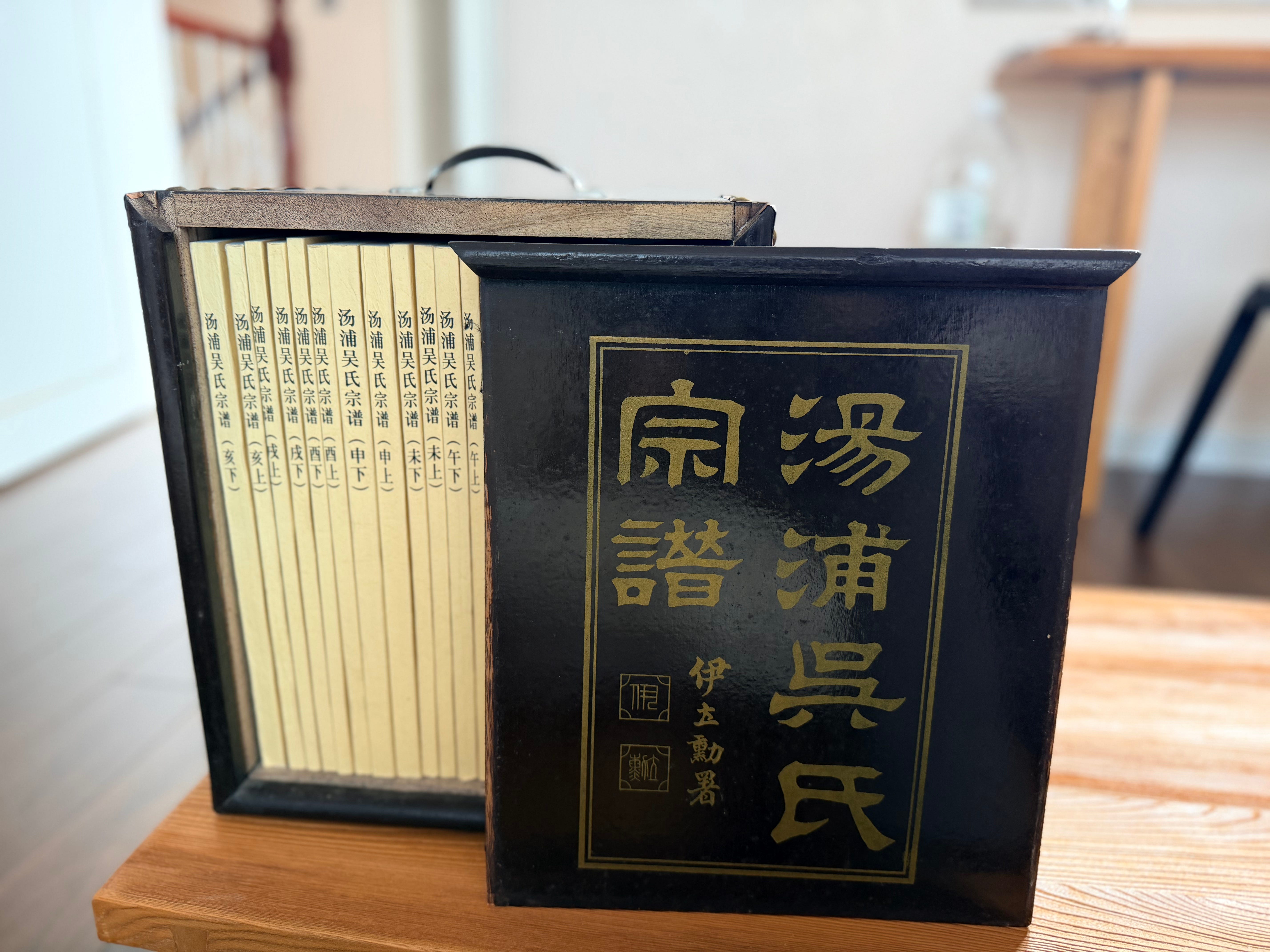
#1 Preface to the 15th Revision of the Tangpu Wu Clan Genealogy
By Wu Shiquan, 38th Generation Descendant, Editor-in-Chief of the 15th Revision March 2010
The Seed of a Dream
In the spring of 2001, while spending the Lunar New Year at my son’s home in Nanjing, our family of five took a weekend trip to Meicun Town in Wuxi. We went to seek the ancient lands of the Wu State and to pay our respects to the enduring legacy of our ancestor, Taibo. Since I was a young child, my father had told me that the birthplace of the Wu surname was Meili (modern-day Meicun). That seed of “seeking one’s roots” was planted in my heart long ago; this journey was the fulfillment of a childhood dream.
Upon arriving at Meicun and entering the Taibo Temple, we paid homage in the Zhide Main Hall. There stands the seated statue of Taibo, the founding ancestor of the Wu clan, wearing a ceremonial crown and royal robes, his feet in red ritual shoes—a figure of dignity and kindness. We moved on to admire the statues of the twenty-four kings of the Wu State and their loyal ministers in the east and west wings before strolling through the temple grounds.
By chance, we came upon the office of the “General Genealogy of the Chinese Wu Clan” committee, then located within the temple. We were warmly received by kinsmen currently working on the records. During our conversation, one kinsman searched the catalog of the Shanghai Library’s Genealogy Department for me. He discovered they held a copy of the Tangpu1 Wu Clan Genealogy. I was overjoyed; the thought of reviving our family lineage took hold of me instantly. I immediately asked my son to visit the library the next time he was in Shanghai.
However, the result was disappointing. The Shanghai collection was a 1916 edition (the Year of Bingchen), but it consisted of only two volumes. It was insufficient for a full reconstruction. We returned empty-handed.
The Bitter Search
To revive a genealogy, one must trace back to the source and clarify the branches of the lineage; this is impossible without an “old record” to serve as a blueprint.
For someone like me, who had never been involved in such work, the old records were essential as a template to follow. In short, trying to rebuild a genealogy without the original records is like building a castle in the air—pure fantasy.
Yet, knowing the Shanghai Library held a fragment, I felt certain that a full copy must exist somewhere in Tangpu or its neighboring areas. Armed with a sincere heart and the conviction that the records could be found, I began a long and arduous search.
The journey was bitter and frustrating. Clues appeared from time to time, but they were all “flowers in a mirror or the moon in the water”—illusions that vanished as soon as I pursued them.
By 2008, my investigation revealed a tragic history: the last time the Tangpu Wu Clan Genealogy had been revised was in 1947, shortly after the victory against Japanese aggression. The work began as the smoke of war was still clearing and was hastily concluded in 1948 amidst the booming cannons of the Civil War.
That edition was ill-fated.
Almost as soon as it was finished, legal disputes over entries led to a lawsuit. The records were eventually declared void by public notice. Aside from a few private copies and some public records, the rest were sealed in the ancestral temple.
During the early years of the Cultural Revolution, the hall was demolished to build a public assembly hall. The records were moved to a private home, and a few volumes were scattered. When the “Smash the Four Olds” campaign swept the nation, the remaining books were seized. Viewed as “feudal dross,” they were left in a local office to rot. Eventually, a flood soaked the building, and the records were destroyed entirely.
As for the private copies held by branches that had moved away, they were either confiscated or quietly destroyed by families fearing political persecution.
We knew that one public copy had been entrusted to a veteran for safekeeping after the revolution. He survived the political movements, and the records remained with him until after the Cultural Revolution. Sadly, he lived a lonely life with no heirs. After his passing, his nephew cleared out his belongings; he took the furniture of value and burned everything else—including the Book.
My hopes vanished in those rising flames. After eight years of searching, I had not seen a single page of our history.
The dream seemed to have turned to ash.
A Turn of Fortune
At the end of 2008, a kinsman named Chuanjia reached out to me, enthusiastically offering his support and a willingness to search together. This reignited my passion. We searched Tangpu and its surrounding areas again and expanded our scope to the libraries and archives of Shaoxing and Shangyu, but the result was the same: nothing.
Then, just as we felt we had reached a dead end, light appeared. One evening in July 2009, Chuanjia and his son, Jianbo, came to my house beaming with joy. As soon as they entered, they shouted: “The genealogy is found!”
I was so stunned I couldn’t react. Jianbo explained: “It’s in the Zhejiang Library. I found it online.”
I asked him to pull it up on the computer. Sure enough, the website displayed: “Tangpu Wu Clan Genealogy, 1916 Xiaosi Hall Woodblock Edition, 36 volumes in 24 books, held by Zhejiang Library.”
Truly, it was a case of “searching for her a thousand times in the crowd, only to turn around and find her there in the fading lantern light.”
I was overwhelmed with emotion. Nearly a century had passed since that edition was printed. I knew that revising the records now would be unimaginably difficult, but I also knew that if we did not do it now, the difficulty would only grow with time until it became impossible. The Tangpu Wu clan would lose its history; we would become trees without roots and water without a source. I vowed then and there:
I will spend the rest of my life completing this genealogy, to honor our ancestors and to leave a legacy for our descendants.
The news spread like wildfire. Supporters gathered, a committee of founders was formed, and the 15th revision of the Tangpu Wu Clan Genealogy officially began.
Immense Challenges
This was the first time the Book of Genealogy was to be revised since the founding of the People’s Republic, and the difficulties ahead were easy to imagine. From the very outset, we were confronted by three major hurdles; had even one of these remained unresolved, the entire project likely would have been abandoned halfway.
Challenge I: The Shift in Mindset
The first great hurdle was a shift in perception. Specifically, was reviving the genealogy even necessary?
The Tangpu Wu clan has a venerable tradition of record-keeping. From the late Tang Dynasty, when we shared records with the Zhoushan and Zhuji branches, to the early Ming Dynasty, when we began our own independent registry, we have been diligent. In the 229 years between the reign of Emperor Kangxi (1718) and the Republican era (1947), the genealogy was revised eleven times, averaging once every twenty-two years. These records served as the sinew of our clan, a tangible bond of kinship that compelled each generation to continue the work.
However, after the 1949 Revolution, a “philosophy of struggle” was championed—one that claimed “there is boundless joy in struggling against others.” This ideology eroded the very foundations of family affection. This peaked during the unprecedented Cultural Revolution, which utterly subverted the traditional virtues of honoring one’s ancestors and harmonizing with one’s kin. Relatives were treated as strangers, or worse, as bitter enemies.
As we began our work, we were met with a constant barrage of skepticism and reproach: “The Cultural Revolution destroyed all the family trees; why bother now?” or “What use is a genealogy in this day and age?” Had we ignored these voices, the project would have stalled. To raise awareness, we issued a “Letter to Our Kinsmen,” widely promoting the idea that documenting our lineage in this era of prosperity is an act of remembrance and a means to reunify the family. We argued that family genealogies, alongside national history and local gazetteers, are the three pillars that support the historical edifice of the Chinese nation. They are cultural heritages highly valued by the state, and the ultra-leftist excesses of the Cultural Revolution must be corrected to set things right.
[redacted]
The second point of contention was the methodology of the revision itself. The focal point of the disagreement was whether daughters should be included in the genealogy. Historically, under the feudal patriarchal system, only males could inherit the family line—a practice that clearly discriminates against women and stands in direct contradiction to our modern Constitution and national policy.
Consequently, we explicitly proposed that only-child daughters and their children (both grandsons and granddaughters) be permitted to carry on the lineage (indicated by a “red line” in the pedigree charts). While this move comforted families with only one daughter, it drew fierce opposition from others: “Historically, only sons get the red line. If daughters can have it too, what kind of genealogy is this?” Some sons-in-law also worried: “If my children are registered in the Wu Clan records, what happens when my own family revises its genealogy?”
With only-daughter households making up nearly half of our families, the project could not proceed without dispelling these prejudices. In our “Second Letter to Kinsmen,” we argued the legitimacy of including daughters from the perspectives of law, national policy, and biological bloodlines. We clarified that a genealogy is not a government household register; a person is not restricted to appearing in only one family’s records. By presenting facts and reasoning, the controversy was finally settled. Not only did these families participate with confidence, but they also donated generously—of the nine households that donated over 10,000 RMB, three were families with only daughters.
Challenge II: Tracing the Ancestral Source
The second major difficulty was tracing ancestral origins. If a clan member cannot find their ancestor in the existing records, they cannot “link” to the lineage, making the revision impossible.
Initially, we worked from the 1916 edition, which was 94 years old. Even an infant recorded in that edition would be 95 today; effectively, not a single person currently alive appeared in those books. To find a link, one needed the names, zodiac signs, spouses, and burial details of deceased fathers, grandfathers, or even great-great-grandfathers who were born before 1916.
This forced us to add an extra step to the process: a comprehensive ancestral investigation. But, while we found matches for many, some kinsmen knew nothing of their ancestors beyond one or two names. Searching for a match in over twenty volumes was like looking for a needle in a haystack. We could neither ignore them nor manufacture a false connection, leaving us in a total deadlock.
Fortunately, a 1947 edition was discovered in the Village of Wujialou shortly after. This closed the gap by 31 years and finally solved the puzzle. (We owe an eternal debt of gratitude to Mr. Bingcan for preserving this record; his story is detailed in a separate entry in Volume Hai).
[Robert: You can find this fascinating story in Articles #2 and #3]
Challenge III: Securing Funds
The costs of such an undertaking are high. Since genealogical revision is a private, grassroots activity, no government funding is available. Given the economic circumstances of the Tangpu Wu clan, no single individual could shoulder the cost alone, and a “per-head” tax would have been insufficient and met with resistance.
We took a different path: voluntary sponsorship with symbolic rewards. We encouraged the successful to give more, allowed those in financial difficulty to give nothing, and asked everyone else to contribute what they could. This proved effective, eventually raising over 300,000 RMB.
We are deeply grateful for this generosity and have treated every cent with the utmost care. Aside from small stipends for those doing door-to-door registration and data entry, all members of the two committees served as volunteers without pay. As a result, we raised enough not only to finish the genealogy but also to allocate half the funds toward rebuilding the Wu Clan Ancestral Hall. To date, the main structure—the Hall of Ancestors—has been completed. This serves as both a comfort to the spirits of our ancestors and a token of gratitude to all who donated.
[Redacted]
#2 How the pivotal 1947 edition was found, literally by a dream
The Dream That Saved Our History
Following the opening ceremony, we worked on two parallel tracks: the door-to-door collection of modern family data and the painstaking search for our ancestral roots. While the data collection went smoothly, the search for our origins was repeatedly thwarted.
The reason was clear: we were relying on the 1916 edition of the Tangpu Wu Clan Genealogy. A century of separation is a vast chasm to bridge. Every time we hit a dead end, a collective sigh would ripple through the committee: “If only we had the 1947 edition... all these problems would vanish.” This became a mantra for everyone involved, especially for Mr.Zhigang, who was assisting me in the search.
As the saying goes, “What you think of by day, you dream of by night.”
Late on the night of October 4th, after an exhausting day of work, Zhigang drifted into a deep sleep. In his dream, he saw a mountain of genealogies in the distance. He rushed forward and grabbed one in his hands, only for it to vanish into thin air. Just as he was overcome with frustration, a mysterious voice whispered to him: “The records you need are in the village of Wujialou!” He woke with a start, realizing it was but a dream.
A Leap of Faith
The next morning, Zhigang couldn’t shake the dream. He thought to himself: Better to believe it might be true than to dismiss it. He knew there was a branch of our clan in the village of Wujialou, and a visit there was already on our schedule. However, because it was “just a dream,” he didn’t dare tell anyone for fear of being ridiculed.
After breakfast, he drove alone to Wujialou. With a mix of hope and doubt, he began visiting kinsmen and spreading news of the project. Eventually, local clansmen led him to the home of a respected elder, Bingcan.
Bingcan had long hoped for a revival of our family records. Without a moment’s hesitation, he brought out his most precious treasure: the 1947 edition of the Tangpu Wu Clan Genealogy, which he had hidden for decades and had never told anyone about. When Zhigang saw the words “Wu Clan Genealogy” inscribed on the wooden chest, he realized his dream had manifested into reality. Overcome with emotion, he dropped to his knees and bowed deeply in reverence.
This display of sincerity deeply moved Bingcan and the onlookers. When Zhigang asked to borrow the records for the committee, Bingcan immediately agreed. Beside himself with joy, Zhigang called our office to report the news. It was nearly noon, and the entire committee was waiting breathlessly for his call.
#3 How the pivotal 1947 edition was saved from destruction
The Secret Guardian of Wujialou
Exhilarating news arrived on the morning of October 5th: the 1947 edition of the Tangpu Wu Clan Genealogy—a set we had spent years searching for to no avail—had been discovered in the tiny mountain village of Wujialou.
The set consisted of twenty-six volumes. Three had been lost to history (held as court evidence in the former Zhejiang High People’s Court due to an old lawsuit), but the remaining twenty-three were largely intact, save for some minor damage from silverfish. After decades of political upheaval and natural disasters, these volumes were the “lone survivors” of a shattered legacy. The man responsible for saving these precious texts was Bingcan, a descendant of the Fusao branch.
An Unlikely Protector
Bingcan was a 36th-generation descendant of our ancestor Wenjian. Since the early days of rural credit cooperatives in 1958, he had worked at the Haoba Credit Union, eventually serving as its director from 1964 until his retirement. He was a man of integrity—down-to-earth, sincere, and widely respected. This public standing provided the “outer shield” that allowed the records to survive in his hands. But more importantly, it was his inner conviction—his deep understanding that a genealogy is the soul of a family—that drove him to act.
The records had originally been kept by a branch leader named Guijin. However, after the 1949 Revolution, Guijin was classified as an “Upper-Middle Peasant.” In that era of radical leftist politics, he realized he was powerless to protect the books and handed them to Chun-yue, a kinsman from a “Poor and Lower-Middle Peasant” background, hoping the political classification would act as a safeguard.
During the “Four Cleansings” movement in 1964, a government work team seized the records to search for political evidence. After the team left, the books were returned, but they were treated with total neglect.
Rescuing History from Playgrounds
Bingcan watched this decline with a heavy heart. He remembered a time when generations before him treated the genealogy as a sacred object, kept in multiple layers of silk and hidden away. In the old days, opening the records was a ritual: one had to wash their hands, change clothes, and burn incense as if visiting the ancestors in person. Now, seeing them cast aside was a desecration. Yet, given the social climate of the time, Bingcan didn’t dare act rashly.
The breaking point came when he saw local schoolchildren, ignorant of what the books were, using the ancient pages as scrap paper for doodling and scribbling. He knew that if he didn’t act, the history of our clan would be wiped out.
Risking everything, Bingcan leveraged his local prestige and his devotion to his ancestors to literally “rescue” the volumes from the children’s hands. Once he got them home, he commissioned a custom camphor wood chest to fit the dimensions of the books, painted it, and carefully inscribed “Wu Clan Genealogy” on the front. He then hid the chest, keeping its existence a secret from everyone.
This happened during the early, most volatile years of the Cultural Revolution. To commit such an “act of righteousness” in that suffocating atmosphere required extraordinary courage and vision.
Not only did Bingcan save the books, but he also became a self-appointed historian; from 1947 onward, he kept a small notebook where he recorded every birth, death, marriage, and burial within his branch, significantly simplifying our work today.
The Missing Link Found
When Bingcan learned that we were officially revising the genealogy, he did not hesitate to offer his cherished collection to the committee. The impact was immediate: Those who previously couldn’t find their ancestors were linked instantly; Doubts regarding “best-guess” connections were resolved with hard evidence; Rare errors where families had linked to the wrong branch were corrected in time.
The role this 1947 edition played in ensuring the quality and speed of our project cannot be overstated. The merit of Bingcan, who guarded these books through the darkest times, is indelible. His name shall be recorded in this genealogy so that he is never forgotten.
#4 An account about the Taiping Rebellion
Original title: 粤匪扰害记A Record of the Disturbance by the Canton Rebels
Since our sage and enlightened Emperors founded this dynasty, the world has long been governed with benevolence. For over two hundred years, the people shared in the blessings of peace. However, during the Daoguang and Xianfeng eras, natural disasters struck repeatedly. Solar eclipses and earthquakes occurred; rivers overflowed, and mountains crumbled. A comet appeared in the sky, trailing like a long bolt of white silk. The strange and ominous portents of that time were too many to recount.
Following these signs, bandits from Guangdong [the Taiping Army] rose up in swarms; they were known as the “Longhairs.” In the autumn of the year Xinyou (1861), they suddenly overran Shaoxing, and the people’s livelihoods were plunged into misery.
Our Wu clan of Tangpu, having previously received imperial decrees to recruit local militia, had prepared for such a crisis. When the rebel forces arrived to plunder our town, we stood our ground and fought them in several battles, both large and small. But alas, we were outnumbered, and our food supplies failed. We held out until the autumn of the year Renxu (1862), when our defenses were finally shattered. Our town was reduced to scorched earth.
In the slaughter that followed, some died as martyrs for the cause, while others chose death over surrender. Our women refused to be defiled; even as they were being beheaded, they chose to remain as ghosts of their home soil rather than suffer dishonor. Some were taken captive, while others scattered to the winds. The old and the young fled for their lives, many perishing in exile—becoming lonely souls wandering in foreign lands. Alas! This was the will of Heaven; what more can be said?
By the immense grace of the Emperor, General Jiang Yili was commanded to lead the land and naval forces. Since breaking the enemy at Quzhou, he cleared the entire province of Zhejiang in less than a year. This allowed our people to return to their ancestral lands, rebuild their homes, and reunite with kin to recount the sorrows of their separation. We have gathered the bleached bones of the fallen and laid them to rest in the snowy mountains.
Ultimately, it was the will of Heaven that restored stability to the state, but it was the exertion of men that suppressed the rebels. As subjects, we shall forever be grateful for the kindness of our Sovereign. Thus, we can say that the will of Heaven, the efforts of man, and the grace of the Emperor are all bathed in the magnificent fortune of the Son of Heaven.
We also rely on the devoted service of our generals. Now, as we undertake the revision of our family genealogy, we specially record these events to honor the fallen and clarify our history. Let future generations read this and remember.
Date: The seventh year of the Tongzhi Reign of the Great Qing (1868).
Tangpu is the township where my grandpa and our ancestors dwelled. Located in today’s Shangyu County, Shaoxing Prefecture of Zhejiang Province.
This is incredible to read. Thanks for the work that went into sharing this
Wonderful! What a great memory to have of your family. Thank you for sharing with the rest of us.