

Welcome to Briefing #71 of China Translated, where I try to make sense of China for you. There are two types of articles in this newsletter. One is the Essays, which include my analyses of key trends and questions of the day. The other one is a Briefing like this one, where I do a quick highlight of recent events that I believe have significance beyond news cycles.
The CXMT IPO
In a highly anticipated event, Chinese memory maker CXMT finally became a listed company. As expected, it became the most valuable company listed across both A-share and H-share on its first day of listing, surpassing ICBC and Tencent.
From an issuance and market-stability perspective, this was a major success.
Things could easily have gone much worse. The nightmare scenario was a repeat of PetroChina’s 2007 IPO: shares were immediately bid up to a stratospheric valuation, then began an excruciating decline that made the company a symbol of the market top. PetroChina, you may have forgotten, briefly became the world’s first trillion-dollar public company, at least on paper.
It is far too early to say that CXMT has escaped PetroChina’s eventual fate. But the immediate disaster many investors feared, a giant IPO draining liquidity and crushing the market around it, did not happen, despite the turmoil and blow-ups in the memory and semiconductor sectors internationally in the past few weeks, hastened by a certain German Wunderkind and some maximally leveraged Korean gamblers.
It's a success story for the Chinese securities regulator as well. It’s clear that ensuring a successful IPO for CXMT is of paramount importance for regulators. On the eve of the IPO, when market sentiment noticeably soured along with the broader fall in global AI sectors, securities regulators and the “National Team” came out hard with clear messaging and hard cash to support the market.
I have long observed that the capital market has transitioned from a secondary matter to a primary policy item, and Chinese regulators’ skill at managing market expectation has grown rapidly. CXMT’s debut is another data point supporting my claim.
Also in the spotlight is Hefei. Long overshadowed internationally by cities such as Shenzhen and Hangzhou, Hefei has gradually built a reputation as one of China’s most consequential technology and industrial-investment hubs. CXMT’s IPO has now pushed that reputation much further into global view.
Measured by the combined market capitalization of locally headquartered A-share companies, CXMT alone catapulted Hefei from 19th place to fourth, behind only Beijing, Shenzhen, and Shanghai.
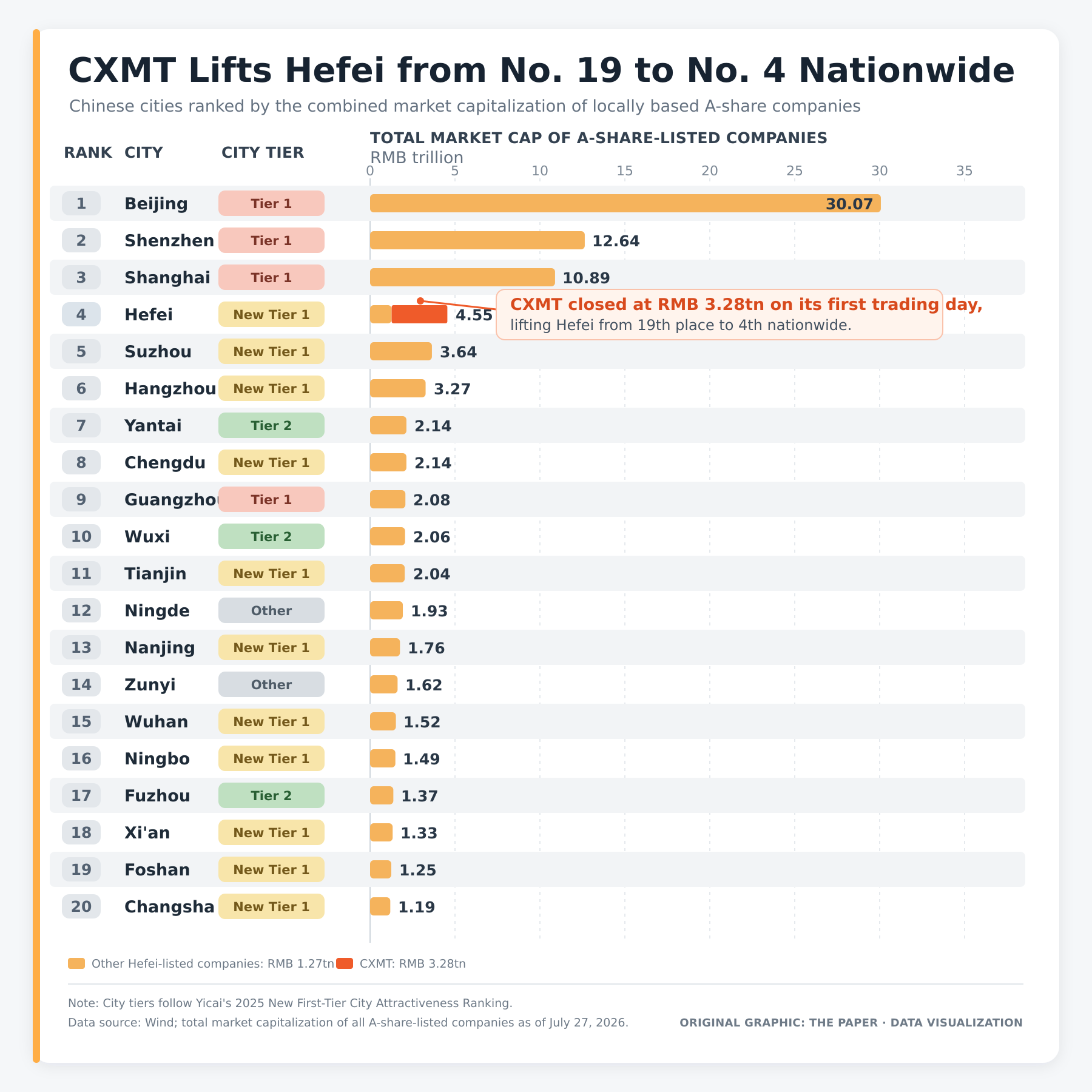
The “Hefei Model” is quite unusual in that it’s where government venture capital places massive, concentrated, and long-duration bets on strategic industries, and several of these bets paid off spectacularly. This is actually amazing, because government funding tends to be risk-averse and isn’t usually associated with roaring success stories.
Naturally, people may ask, given Chinese local governments’ tendency to neijuan, will more cities in China follow suit?
Well, I wrote a long article about it two weeks ago, but my conclusion is simple: No. This is probably one of the rare cases when, although one city may have a stellar success, it’s not easy for other cities to follow suit and copy.
You can replicate success and scale it up if capital is the main constraint. But when it’s serendipity, people factor, and something as rudimentary as “having guts” that’s at stake, there is really no clear roadmap.
You can find more details about it here:

I want to do this kind of short, single-issue briefings more frequently. Here are some other recent events that I find interesting. Which ones do you want to hear my takes about?
I'd still ask them, both are approachable, but everyone has to follow their path.