

Time really flies! China Translated’s first year anniversary just felt like yesterday, but we are fast approaching its second birthday already.
I am also glad to share that at this very moment, my subscriber list has just broken the 6,000 mark. For a personal newsletter that I can’t yet commit to a fixed schedule for, I consider this not bad.
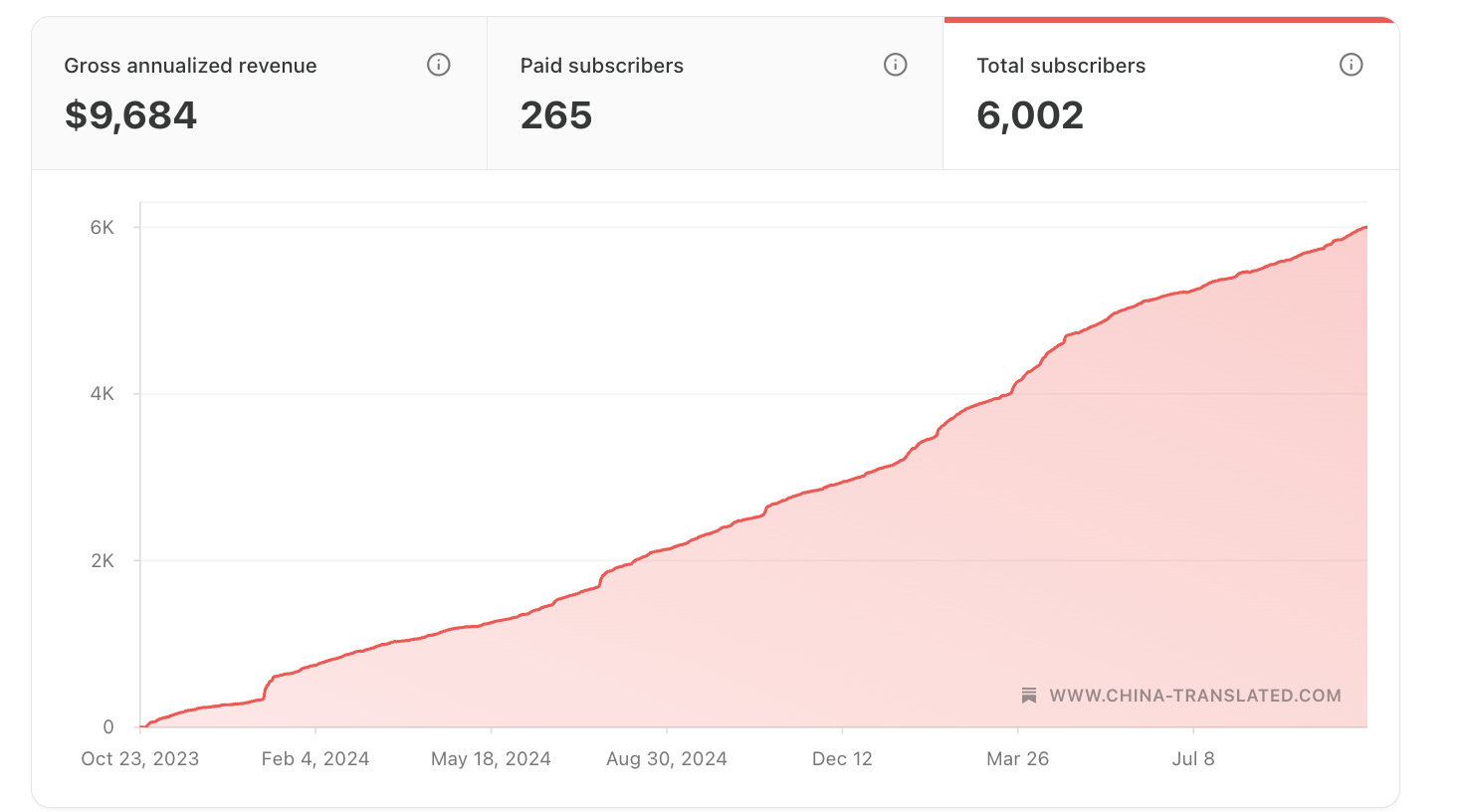
But I am also keenly aware that all of this won’t happen without your continued support! My gratitude is especially extended to the 95 of you who are paying for my work, and the 170 of you who paid for Baiguan and took the trouble to ask me for the complimentary access that I promised. (If you are a paying subscriber of Baiguan but don’t have the comp access here yet, make sure to send me a private message.)
For this anniversary, I will do the same two things that I did for the last one, and probably for every anniversary in the future.
First, in a few weeks, I will update my Master Plan to incorporate the latest highlights (the linked version is not updated yet, but you can take a look if you haven’t.)
Second, as many of you know, this is a moment to ask me anything! What do you want to know more about me? What do you need me to elaborate on? What do you think I am wrong about? Just ask me anything! I will try my very best to entertain your questions, even sensitive ones. In fact, my last year’s answer post turned out to be one of my most popular posts yet. I will consolidate my answers in a future post.
How to ask me? If you read this from your email, just reply to the email with your questions. If you read from the Substack App or china-translated.com, just leave your questions in the comment section.
I am also glad that this year has witnessed me branching out into more niche newsletters. And if you haven’t already, subscribe to
Robert Wu’s Portfolio, to see how I put my beliefs into investment action
Data Currency, to follow the professional data, information, and research industry in Asia that I am part of
CF40 Research, a newsletter straight from China’s most prominent economic think tank that we at Baiguan helped manage
At last, let me share again what I think is my proudest work in the last 12 months:
The series on China’s low-trust society (or is it rapidly transitioning into a high-trust society now?)
Sharing my unique experience as an early co-founder of Ginger River Review, a newsletter founded by a state media employee
Consolidating all my discussions about the US-China power struggle into my own phrase: The Great Divorce. (And of course, my own experience of writing an opinion piece in the New York Times bashing Trump at the height of the tariff war.)
Why the usual “I am against the CCP but not against Chinese people” refrain is not that meaningful
My discussion of the “Century of Humiliation” narrative
Revisiting my old argument against Noah Smith, that China is comparatively not warlike (Part 4, Part 5, Q&A)
Reviewing what really brought down Jack Ma (before his revival, of course)
What I think was the most dangerous moment in China’s recent history that few people talked about: the possibility of siding with Nazi Germany.
This one was written at Baiguan, where I shared my key reasoning for a decade-long bull market in China.
That’s it for today. let me say it once again: ASK ME ANYTHING!
Six questions:
1. As a CEO of a Chinese startup, if you were to start going to your workplace by bicycle, how do you expect your colleagues, your employees and business partners would react to it?
And, would it make a difference if the bike is ordinary (mechanical) or an e-bike?
2. How does the work culture in the Chinese work environments you can speak about compare to the American work culture described in the comments' section here https://www.youtube.com/watch?v=av3CHCu2zBM ?
3. You wrote that "Using a VPN is illegal in China" (https://www.china-translated.com/p/can-you-criticize-xi-jinping-in-china/). Would you please cite the relevant section of the criminal code and which section or article it comes under?
Here's the link to the Criminal Code in English : https://www.cecc.gov/resources/legal-provisions/criminal-law-of-the-peoples-republic-of-china
4. Mencius: "There are three things which are unfilial, and to have no posterity is the greatest of them." (Mn. 4A.26). Among the current generations of Chinese, does failure to have descendants cause a sense of guilt? If so, in what percentage of childless people, and to what degree?
5. For a good while, it used to be the case that the Chinese were more materialistic rather than idealistic or spiritual. But, the young generations tend to perceive a need for more spirituality. And, meanwhile, China proved rather outstanding in systematic studies, in sciences. My question is: How do the Chinese stand regarding scientific studies that suggest an existence of a spiritual domain? Viz., studies of Chi Gong, of 'distance healing,' and "near-death experiences." Can you go to WeChat, enter a bookstore or a library, and find works on those topics? How much public interest there is for those fields?
6. What would be your take on these accounts of the dramatic Tianamanmen Square events in 1989?
i) https://americanaffairsjournal.org/2018/02/surprise-authoritarian-resilience-china/
ii) https://twitter.com/zhao_dashuai/status/1665135146004013058
iii) https://www.unz.com/article/tiananmen-square-1989-revisited/
After electric cars and solar, which next cutting-edge technologies do you expect China to take the lead on?