

A while ago, I conducted a poll here asking for your preference about the next topics to write about. The overwhelming majority chose the one about my observation of the “lying flat” phenomenon. True to my word, I have already published that one as a free post on Baiguan.
Let me also use this as a small note for new subscribers about the difference between this newsletter and Baiguan. Baiguan is data-focused and is much more business and investment-focused. It is intended for anyone who has a real stake in China. It’s a product of my own company. We do data and information services for institutional investors and corporates.
This newsletter, China Translated, is my personal newsletter, where I try to explain the social, political, cultural, and historical contexts to help you make sense of what is happening in China.
Now, with my obligation to you fulfilled, today I will write about the topic I actually wanted to write about the most among the 3 topics in that poll: an interesting encounter at the (destroyed) tomb of Dai Li, often seen as Chiang Kai-shek’s Himmler/Beria/Hoover, which is a nice little showcase of how grassroots governance plays out in today’s China.
Nanjing, the old capital
Early subscribers to this newsletter know that I was born and raised in the city of Nanjing, China’s former capital before Beijing took that role.
When Chiang Kai-shek assumed power of the Kuomintang in 1927, and by extension the Republic of China (ROC) government, he decided to place Nanjing (or Nanking) as the capital. That was until 1949, when the communists took over, and Chiang fled to Taiwan.
Given this historical context, it is no surprise that Nanjing is full of important KMT-era sites. For instance, Sun Yat-sen, the founding father of the ROC, was buried in the mausoleum in the Zijin Mountain not far away from Nanjing’s city center. Chiang’s “White House”, the presidential palace, was turned into a popular museum.
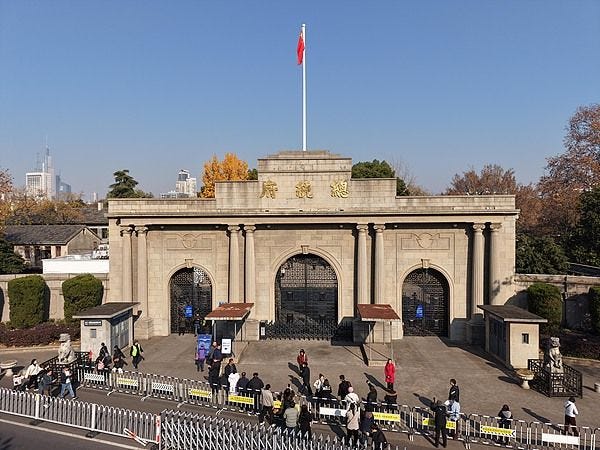
This past Ching Ming festival, almost two months ago, several friends and I visited another KMT-era site we had never been to before: the Ling Gu Temple 灵谷寺. Although it is a temple dating back to the 6th century, its surroundings are closely intertwined with the history of the Kuomintang.
Take, for example, the Wu Liang Hall 无梁殿, or the Beamless Hall. The structure was built entirely from the bottom up with bricks, without a piece of wood or a single nail, and thus “beamless”. It used to be a Buddhist temple, but in 1928, it was turned into a memorial that eventually enshrined more than 30,000 lost souls in the Kuomintang army, with all their names carved on the walls.
They were the Kuomintang’s casualties during the Northern Expedition against the warlords, the 1932 Battle of Shanghai against the Japanese, and the 1933 Defense of the Great Wall, also against the Japanese. (But for the much bloodier War of Resistance Against Japan that started in 1937 and ended in 1945, claiming the lives of more than 3 million soldiers and at least 10 million civilians, the Kuomintang obviously didn’t have enough wall space, nor enough time, to carve down names.)
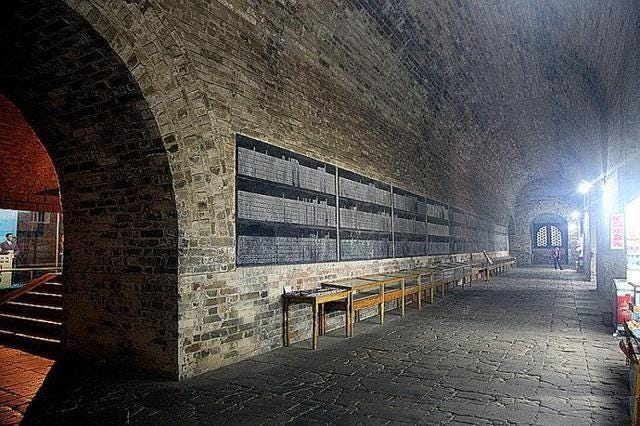
In the lawn outside the Beamless Hall, the remains of 316 KMT officers and soldiers, representing all the fallen, were buried.
So, this whole place, essentially, is ROC’s equivalent of Arlington National Cemetery.
Besides the Beamless Hall, there are also mausoleums of several KMT-era heavyweights that I won’t bore you with.
But to be very honest with you, the single place that got me most interested in going to Ling Gu Temple was the destroyed tomb of one of the most consequential, most controversial, and most mysterious individuals of that era: Lieutenant General Dai Li, more commonly known by his subordinates as “Boss Dai”.
Who is Boss Dai
Born as Dai Chunfeng 戴春风 with the courtesy name Yunong 雨农 in 1897 in rural Zhejiang province, he spent his early years drifting before eventually enrolling in the Whampoa Military Academy. It was there that he caught the eye of the academy’s commandant: Chiang Kai-shek. Recognizing Dai’s fierce intellect and absolute devotion, Chiang brought him into his inner circle.
Dai soon changed his name to Dai Li 戴笠, a name translating to “wearing a bamboo hat,” symbolizing an anonymous servant or an assassin in the shadows. True to this new moniker, he was tasked by Chiang with a monumental undertaking: building China’s first modern secret police system from the ground up. This organization, the Bureau of Investigation and Statistics of the Military Commission, or Juntong, would grow into a formidable, invisible empire of intelligence, espionage, and assassination.
When analyzing Dai Li, it is tempting to compare him to the other notorious secret police chiefs of his era: Nazi Germany’s Reinhard Heydrich, the Soviet Union’s Lavrentiy Beria, and America’s Hoover. (Barbara Tuchman once called Dai “China’s combination of Himmler and J. Edgar Hoover”.)
Like those figures, Dai Li was meticulous, ruthless, and highly effective. But he was a distinctly different kind of operator. He did not operate on the genocidal, industrial-killing scale of Heydrich, nor did he possess the perverse sadism of Beria. And while Hoover spent his career hoarding secrets to make himself untouchable, effectively holding US presidents hostage to his power, Dai Li did the exact opposite. He pledged his life, his agency, and his complete devotion to one man and one man only: Chiang Kai-shek. He was deadly loyal, acting as the sword and shield of the Nationalist leader without ever seeking the throne for himself.
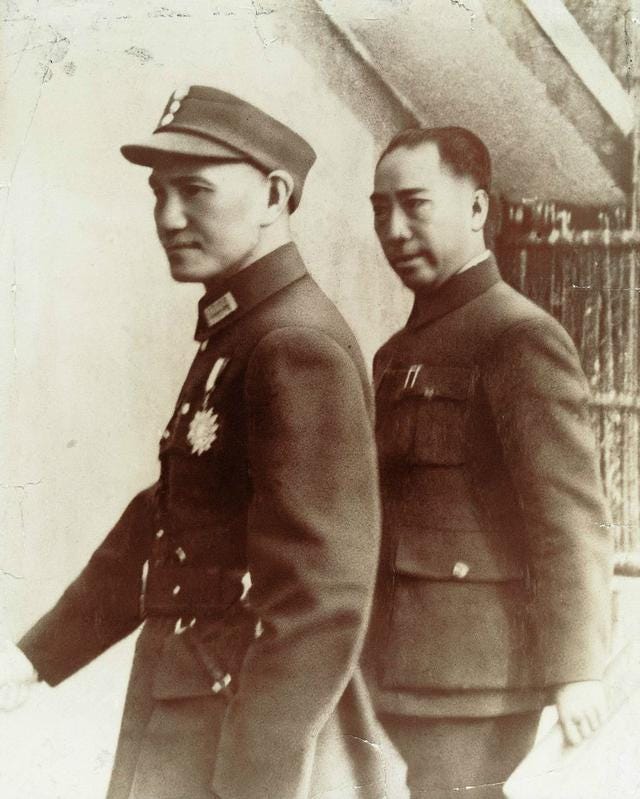
Boss Dai’s story is one of history’s great “what ifs.” By the end of World War II, his intelligence network was vast and feared. He could have made an even higher mark in history, and Chiang himself allegedly lamented that he would not have lost mainland China and fled to Taiwan had Dai Li’s life not been cut short unexpectedly.
On March 17, 1946, Dai died (no pun intended) when his plane crashed into a hillside called Dai Mountain (different character, same pronunciation) near Nanjing during a violent thunderstorm. Given his line of work and the number of enemies he had amassed, rumors of assassination immediately swirled and persist to this day.
His funeral was a grand, state-level affair, drawing massive crowds and the highest ranks of the Nationalist government. Chiang, a man rarely known for public displays of emotion, was reportedly deeply devastated by the loss of his most trusted weapon.
Because Boss Dai had hunted and executed thousands of Communist agents, Chiang Kai-shek knew that if the Communists ever took power, the remains of his spymaster and close confidant would be a prime target for vengeance. Consequently, Chiang ordered Dai Li’s burial site, located just outside Nanjing near Ling Gu Temple, to be built like an impenetrable bunker. The coffin was encased in exceptionally thick reinforced concrete laced with coal slag, designed to make grave-robbing or desecration nearly impossible.
Chiang’s foresight was correct, though his concrete plan ultimately failed. In 1949, the Communists won the civil war, and the Nationalists fled to Taiwan. Not long after, in 1951, the new People’s Republic of China authorities ordered the destruction of Dai Li’s tomb.
The reinforced concrete proved so incredibly tough that local laborers spent days fruitlessly hacking at it with pickaxes. Eventually, they had to resort to using heavy explosives to finally crack the tomb open. Once breached, the coffin was smashed, and Dai Li’s remains, already charred from the 1946 plane crash, were dumped out, abandoned, and the grave was leveled to erase his memory from the landscape.
Locating the site
Given the rich story about this colorful figure, when some friends suggested we visit Ling Gu Temple this time, and that the tomb of Dai Li was somewhere nearby, I shouted, “Hell yeah, let’s go!”
It was not an easy place to find. There were no public signposts. Nor was it marked on the map app. Obviously, this is a place that has been intentionally obscured from public memory.
However, we did find occasional travel notes about it on Rednote (Xiaohongshu), and we relied on them to locate the site. The existence of those notes on the public internet is proof that this site, although left to fade, is not sensitive enough to warrant a total erasure.
According to the notes on Rednote, we first need to find a public cemetery for some KMT soldiers, then walk a few hundred meters to the left until we see a circular stone structure lined with trees.
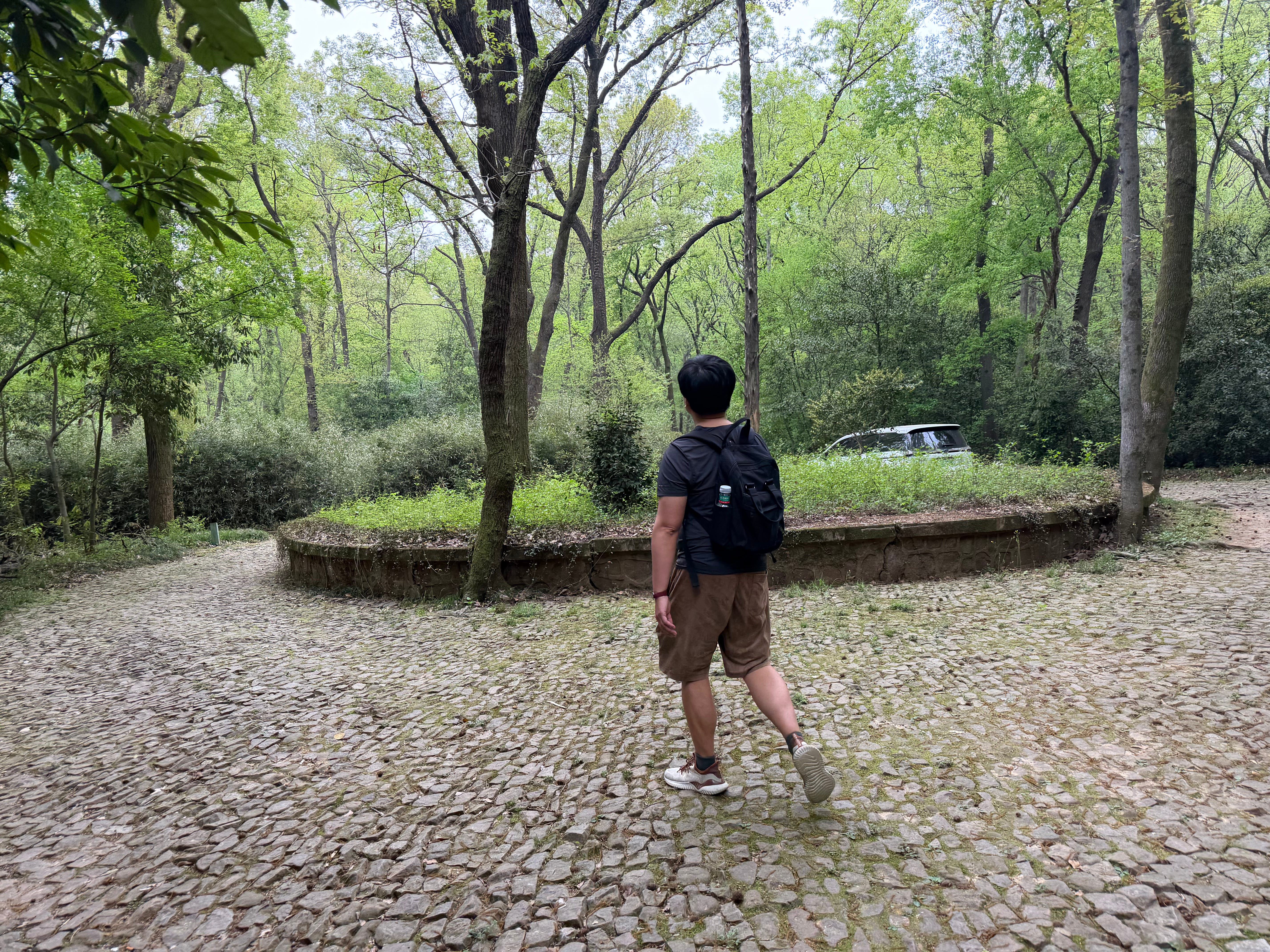
Around the circular stone structure, there was a paved way. We should keep walking along this paved path for a few hundred more meters until we reach a little pond.
The tomb is by that pond.
I was worried we still couldn’t find it despite these instructions. But my worries were quickly swept away when, as soon as we saw the little pond, a guy looking like a park guard emerged.
He was the only person we saw in the last 30 minutes since we went off the beaten track. He was not a policeman, just someone with a park service uniform. He must be there for a reason, like a marker for something.
He must be guarding Boss Dai's tomb!
The guard stood at the gate of a small courtyard, lined by bushes. We walked past the guard and got into the courtyard. There, we found another man, dressed in a casual jacket, sitting in a portable chair, playing on his phone. He didn’t look like a random tourist to us.
The guard in uniform watched us intently as we entered, but didn’t say a word until one of us took out the phone.
“No photos allowed here”. The guard, who looked to be in his early 20s, spoke to us.
“But can we visit?”
“Yes, but no photos.”
“There was nothing left here,” casually commented the mysterious sitting man, eyes barely moving away from his phone when he spoke.
When we walked deeper into the courtyard, the guard followed us. About 30 meters in, we saw a stone slab lying on the ground. The marked words on it were entirely unintelligible. But it was clear this was the tombstone of Boss Dai. The words on it seemed to be intentionally scrubbed out.
“No photos”, urged the guard again, afraid that we would sneak up a photo of this unspectacular piece of rock.
There was indeed nothing else to see, and so we went away.
The second attempt
The whole experience baffled me greatly.
The presence of guard(s?) was totally unexpected. Dai Li passed away more than 80 years ago. Why is he even sensitive now? I doubt many young people would even know him. And I doubt even more that there are enough people who want to politicize him. Even Chiang Kai-shek has been somewhat depoliticized and is no longer the supervillain that Mao-era propagandists once portrayed him to be.
If even Boss Dai’s own boss was not as hated as before, why would they care about little Boss Dai? Why is this extra security even needed here? Has this arrangement always been there? It will be quite amazing if the PRC has been guarding the destroyed tomb of its former archenemy through all those years.
That evening, at my partner’s home, we told her parents the story. They suggested that the security presence we saw was likely not there all the time, but might be because that day was the Ching Ming Festival, also known as the Tomb-sweeping Festival, which is traditionally when people pay respects to the deceased.
This makes more sense, which also reminded me of another fact: Dai Li was killed by that fateful plane crash on March 17, 1946. We were almost exactly on the 80th anniversary of that event, adding an extra layer of sensitivity.
If this is the case, we reasoned, the security might be reduced later, and we should be able to take a photo.
So the next day, we visited again.
This time, since we already knew the way, we went straight to the target. Ling Gu Temple. The Beamless Hall. KMT public cemetery. Circular stone structure. Paved road. We stormed past each landmark in quick succession.
Very soon, we hit the little pond. But our hearts sank when we saw that young park guard again, this time standing on the bank of the little pond, in pensive thought.
Maybe we should have a chat with him.
“Hey, man, good job. Are you here all the time?”
“Nah, just these few days.”
“Is it because of the Ching Ming Festival, and also because of the 80th anniversary?”
“Yes, but also because, don’t you know, the chairlady of KMT is coming?”
Oh absolutely! How did we forget about that? Cheng Lin-wun, the new chairperson of KMT, was coming for a historic visit. In fact, the day of our second visit was on the 6th of April, while Cheng would arrive exactly the next day, on the 7th, and her very first stop would be paying homage to Sun Yat-sen’s Mausoleum nearby.
Obviously, in days like these, Chinese authorities don’t want anyone to use sensitive sites like Boss Dai’s destroyed tomb to make a political message. After all, Boss Dai served Chiang, who was perhaps the most consequential predecessor of Cheng as the head of the KMT. Theoretically, there is a possibility, however remote, that people with an agenda could use a photo of this place to try to derail the show.
We then notice that the guy in the casual jacket who was sitting there the previous day was not there. The young park guard was there all alone.
“That guy yesterday, he must be painclothes?” We asked.
“Yes. He came from the sub-branch. He is not coming today.”
By “sub-branch”, we assumed he meant the sub-branch of the local police office. But we didn’t ask further.
The sub-branch guy’s absence suggested this was sort of a gradient system. The most sensitive day is dealt with the heaviest arrangement, which would fade away as time goes by. Very soon, that lonely young guard would leave this post too, leaving tourists to do literally whatever they want with this site.
Overall, we were just amazed by the granularity and pragmatism of China’s grassroots management in this episode. They were not stupid enough to waste resources on putting a 24/7 guard at a supposedly sensitive site that very few people care about. But on special days, someone higher-up, sitting in an office somewhere, would still remember to send his/her subordinates a special assignment, if just to kill a one-in-a-million chance of some big trouble.
Whatever you want to say about the Chinese government, they are usually not sloppy.
The Sword
And we did take the photo!
While I chatted with the guard, my partner went in and snuck up a photo of the fallen slab.
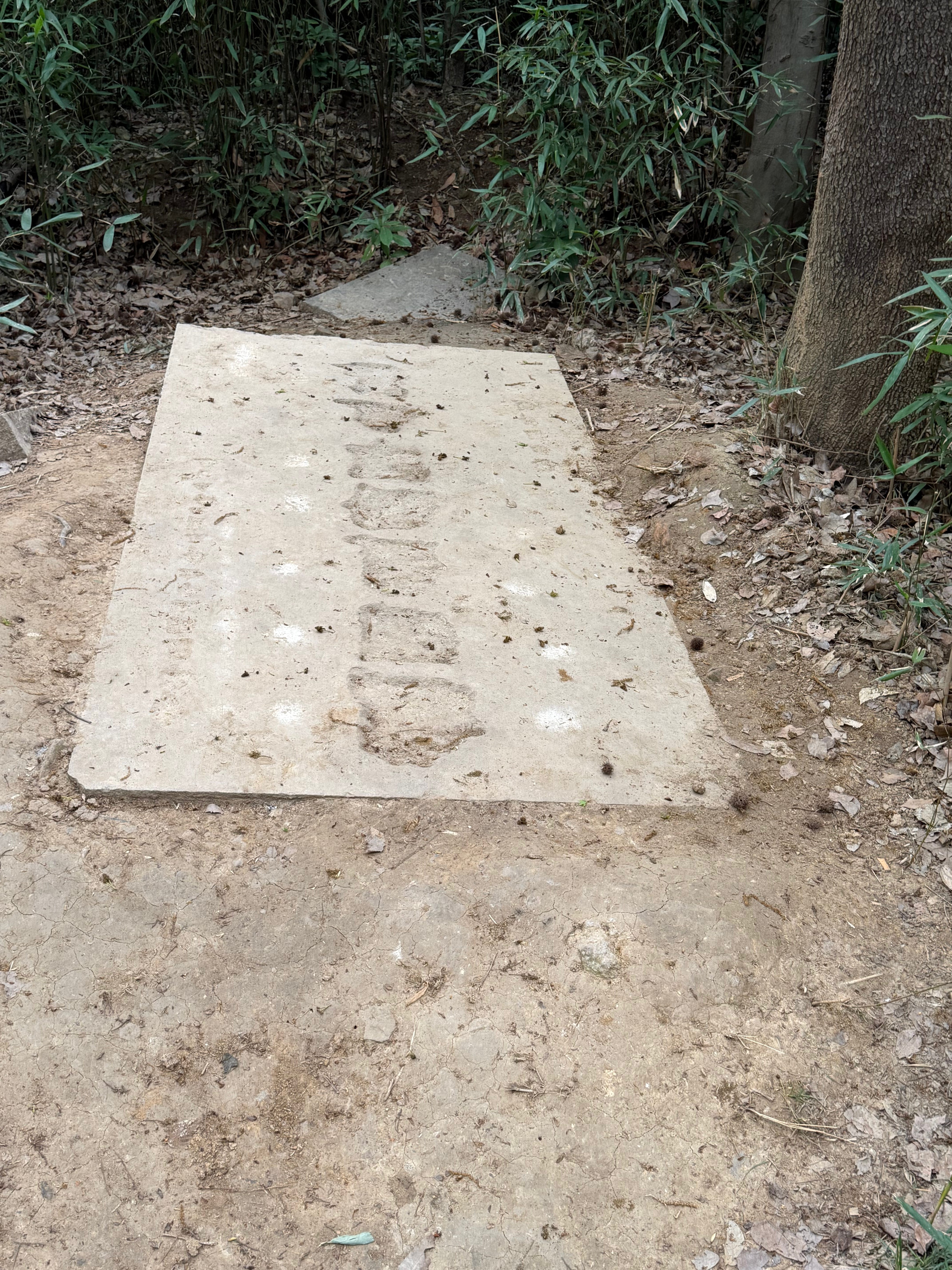
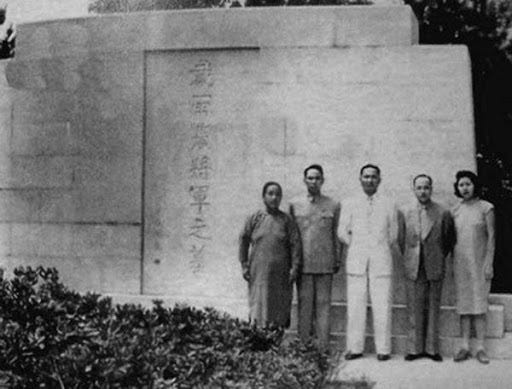
You see, nothing intelligible. But we knew from historical records that it said “戴雨农将军之墓 The Tomb of General Dai Yunong”, as shown in this old photo I found on the internet:
And there is one last thing I want to mention here. That pond.
The pond is dirty, blanketed by algae. But despite its humble appearance, it’s also, in some sense, a historical site: After Boss Dai’s tomb was trashed, his charred remains were thrown into this very pond.
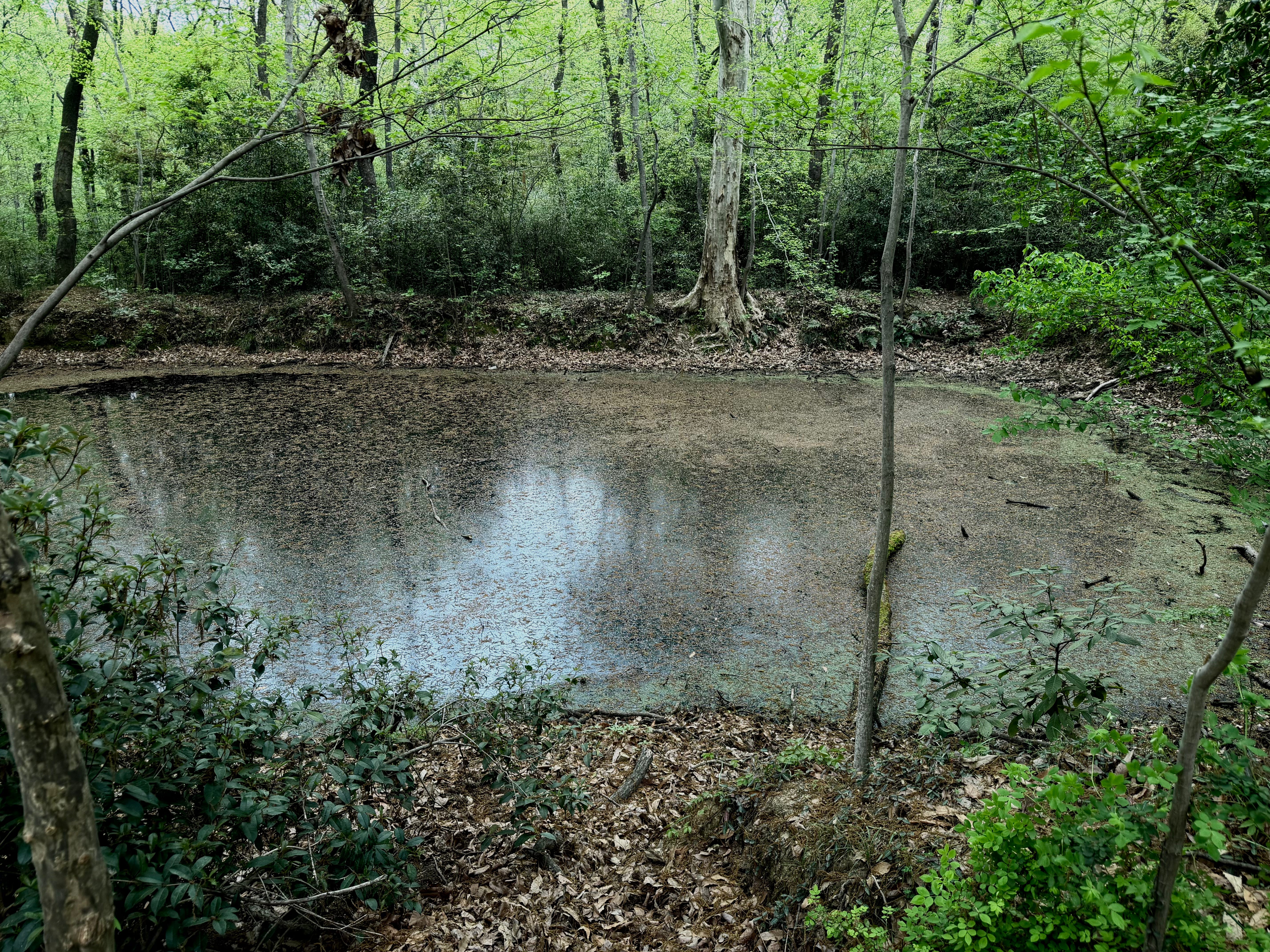
Also thrown in there was the destroyed “nine-dragon” sword that once belonged to the Qianlong Emperor of the Qing Dynasty. This is an amazing story tied to the Eastern Mausoleum of the Qing, a site I visited last year, but I never finished Part 2 of that travelogue due to what seemed like a lack of interest on your part.
You see, back in 1928, after the local warlord Sun Dianying blew up and looted several high-profile mausoleums, including those that buried the Empress Dowager Cixi and the Qianlong Emperor, Sun presented this priceless weapon to Dai Li as a bribe intended for Chiang Kai-shek. However, amid the chaos of World War II, Dai Li temporarily entrusted the relic to a subordinate, Ma Hansan, head of the Juntong system in Northern China. Treacherous and greedy, Ma secretly kept the sword for himself, eventually using it to buy his own life after being captured by Japanese forces by passing the blade to the infamous Manchu spy Kawashima Yoshiko. When the war ended, Dai Li interrogated Yoshiko and recovered that sword.
Then, he boarded that fateful plane to see Chiang, carrying the sword with him.
A young park guard, all alone, brooding over the dirty little pond that stored whatever remained of Dai Li’s body, and of Qianlong Emperor’s 9-dragon sword, as if he is the last tomb keeper of Chiang Kai-shek’s sword and shield, as if the once-feared creator of China’s first secret police system would one day be “protected” and watched over by his former enemies, is a scene that will never be erased from my memory.
Related readings
Why is China not attacking Taiwan? (Full version)

The US is getting bogged down in a disaster in Iran right now, and despite Trump’s many lies, the war doesn’t seem to end anytime soon.
Do weak powers have no diplomacy? Or is diplomacy their only play?

There is an often-cited saying in China: “A weak power has no diplomacy弱国无外交” meaning weaker powers can not dictate the terms of international relations and can only try to survive at the mercy of big powers.
What role does technology play for China's transition from a "low-trust" society to a potentially high-trust one?

To date, the most popular article on China Translated is my essay on China’s “low-trust” society. My central thesis in that article is that Chinese people maintain a very low level of trust regarding strangers, and people are deemed “untrustworthy until proven otherwise”, rather than the “innocent until proven otherwise” verdict more commonly found in t…
Interesting. In "Avatar the last airbender," there was a character named Dai Lee. Almost everything matches!!!
Kang Sheng, China’s Beria, has a grave that is even harder to find. And someone is certainly keeping an eye on it.