

Yesterday, China caught a falling rocket.
At 12:15 p.m. on July 10, the Long March 10B lifted off from the Hainan Commercial Space Launch Site. It successfully delivered a satellite into orbit. About six minutes after separating from the second stage, its first-stage booster returned vertically toward Earth and was caught by a giant net stretched across a recovery platform at sea.
It was China’s first successful controlled recovery of an orbital-class rocket booster, and the first time anywhere in the world that such a booster had been recovered using a net. China is now the second country, and roughly the third organization after SpaceX and Blue Origin, to accomplish this feat. The recovered booster is expected to fly again before the end of this year. Only then will it graduate from “recovered” to genuinely “reused.”
When videos of the recovery began spreading across overseas social media, they were immediately met with familiar forms of skepticism. Some people assumed that the footage had been generated by AI. Others said that China had, once again, stolen the technology.
Let us first dispose of the stupidest part of this discussion: the event was real. The rocket launched. The satellite reached orbit. The booster returned. The recovery platform caught it. The event was documented from multiple angles and reported by Chinese and international media. We are now living in an age when extraordinary footage is presumed fake until proven otherwise, but disbelief is not evidence.
The more interesting accusation is that “China stole SpaceX's technology.”
This is also wrong, although for a more instructive reason.
SpaceX actually uses two different approaches to recover its rockets. Its workhorse Falcon 9 returns on deployable landing legs, touching down either on land or on an autonomous drone ship. For Starship, SpaceX eliminated the landing legs and instead catches the Super Heavy booster with two mechanical arms attached to the launch tower, the system popularly known as the “chopsticks.”
China’s Long March 10B uses neither.
From the footage, it seems that Long March 10B eliminates the Falcon-9-style heavy landing legs, but instead of requiring the booster to thread itself between two rigid mechanical arms like Super Heavy, the rocket deploys hooks near its lower section as it descends. These hooks engage with tensioned cables and a large flexible net installed on the sea platform. The net and its buffering system absorb much of the booster’s remaining kinetic energy.
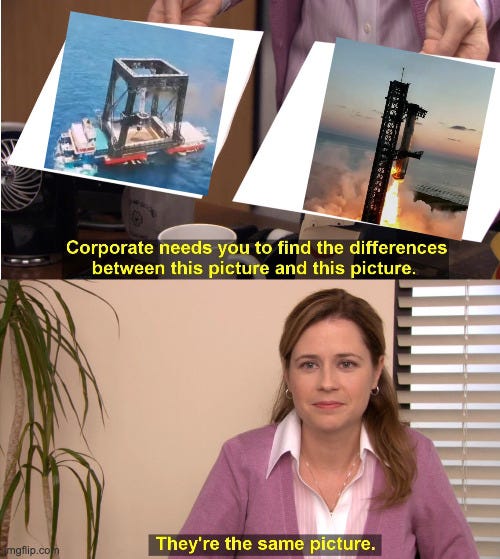
The broad objective is the same as SpaceX’s: do not throw away the most expensive part of the rocket after each launch. But the engineering architecture is clearly different, and in fact may offer several advantages.
On the one hand, it shifts part of the recovery burden from the rocket to the platform. Without landing legs, the booster can save weight and devote more of its capacity to payload. On the other hand, a flexible net may also tolerate a larger landing error than a rigid platform, reducing the precision demanded of the rocket during the final seconds of descent.
The trade-off is that recovery depends on specialized infrastructure and introduces a different set of engineering problems involving sea conditions, cable dynamics, hooks, and the stabilization of a very tall object suspended in a net.
Of course, China learned from SpaceX. SpaceX demonstrated that a large orbital booster could return through the atmosphere, restart its engines, navigate toward a small target, and land in a condition suitable for reuse. China’s rocket follows the same basic sequence and is governed by the same physics. But physics does not belong to Elon Musk. Neither does the general ambition of making rockets reusable.
Nor is most of the underlying science secret. Rocket propulsion, aerodynamics, guidance, materials science, and control theory are all well-established fields. The difficulty lies in systems engineering: making thousands of components behave correctly simultaneously, under extreme heat and pressure, with almost no tolerance for error.
That requires enormous amounts of tinkering, testing, and failure. China is very good at that kind of engineering.
But there is one thing China did take from Musk, which also contributes to the lingering perception that China is copying him, and is the single most important contribution Musk made to China’s technological innovation. It is just one sentence:
“This can be done.”
What China really took from Musk
A striking aspect of the technological competition between China and the United States is that it sometimes feels like a competition between China and a single American.
Tesla proves that an electric car can become a globally desirable consumer product. China, already investing in electric vehicles, gains a powerful market benchmark and accelerates its efforts.
SpaceX proves that reusable rockets are commercially meaningful. China develops its own reusable rockets.
SpaceX builds Starlink. China begins constructing competing low-Earth-orbit satellite constellations.
This description is obviously exaggerated. The United States has many other important technology companies, while China’s industrial strategy is not created in response to one man’s Twitter feed. But the pattern is real enough to deserve examination.
Musk is unusually willing to pursue projects that initially look absurd. Once one of them works, China is unusually good at turning that proof into an industry.
Consider electric vehicles.
BYD was not created in response to Tesla. It began as a battery manufacturer in 1995 and entered the automobile industry in 2003, the same year Tesla was founded. China had already made electric-vehicle research a national priority in 2001, years before Tesla sold its first Roadster. BYD launched its first plug-in hybrid, the F3DM, in 2008.
It would therefore be historically wrong to say that Musk introduced China to electric vehicles.
What Tesla provided was something subtler and perhaps more consequential. It demonstrated that an electric car need not be an inferior substitute purchased out of environmental duty. In fact, an EV could be faster, more desirable, and more technologically advanced than a gasoline car. Tesla turned the electric vehicle from a fringe research program into an object of consumer aspiration.
The arrival of Tesla’s Shanghai factory in 2019 reinforced that effect. Chinese policymakers were willing to give Tesla unusually favorable treatment partly because they expected it to function as a “catfish,” forcing domestic manufacturers to swim faster. Tesla became a visible benchmark for vehicle software, manufacturing efficiency, direct sales, and consumer appeal.
Chinese companies did not simply reproduce that benchmark. They scaled and refined plug-in hybrids, built battery-swapping networks, integrated supply chains, lower-cost batteries, and a bewildering variety of models aimed at almost every price segment. They are now forcing Tesla to respond.
This is often how Chinese technological development works. China may begin as a follower, but it rarely remains a passive imitator. Once the direction has been validated, competition, manufacturing scale, and rapid iteration transform the original concept.
The value of external proof
China does not lack imaginative scientists, ambitious entrepreneurs, or technically difficult ideas. What it often lacks is permission to commit enormous resources to an idea before anyone knows whether it will work.
Any new technological frontier requires a coalition. Government agencies must approve it. Investors must finance it. Suppliers must reorganize around it. Local governments may need to provide land and infrastructure. Talented engineers must be persuaded that the project will survive long enough to justify years of their careers.
In China’s consensus-heavy system, the hardest part is not solving the engineering problem. It is persuading enough stakeholders that this particular engineering problem deserves to be solved.
If you really think about it, the downside of supporting an eccentric and unproven project is tremendous. If it fails, everyone involved may be asked why they wasted so much money on an obviously unrealistic idea. Everyone around them will be laughing at them. On the other hand, the upside is harder to claim in advance, so this whole dynamic naturally encourages people to wait.
However, external success changes the political economy of the decision.
Once SpaceX has landed hundreds of rockets, reusable launch vehicles will no longer be one billionaire’s fantasy. They become strategic infrastructure. The question changes from “Why should we attempt this?” to “Why are we still behind?” Budgets become easier to justify. Investors become more comfortable. Engineers become easier to recruit. Failure becomes acceptable because the destination itself will no longer be in doubt.
This is what Musk gives China: social proof.
The same dynamic may eventually play out with space data centers as well. Musk argues that orbiting computers powered by solar energy could escape the electricity, land, and water constraints faced by terrestrial AI infrastructure. SpaceX has even filed for permission to deploy a constellation that could eventually contain as many as one million computing satellites. For now, the economics remain deeply uncertain, and SpaceX itself has warned investors that orbital data centers may never become commercially viable.
China is not ignoring the concept. In fact, it launched the first 12 satellites of its “Three-Body Computing Constellation” in May 2025 and has already tested AI models and inter-satellite computing in orbit. China’s main space contractor has also proposed gigawatt-scale space computing infrastructure.
Still, I doubt China will rush to achieve it before SpaceX and would rather wait a bit. Yet, if SpaceX eventually proves that orbital computing works economically at scale, I assure you China’s response will be swift.
Where is China’s Elon Musk?
I believe China may eventually produce its own version of Elon Musk: someone bold enough to choose a frontier before the rest of society considers it sensible, and someone whom the system is willing to tolerate through repeated failures.
But that person does not fully exist today. This is not because Chinese entrepreneurs are less intelligent or less ambitious. It is because an Elon Musk requires more than a particular personality. He requires an environment in which one eccentric individual can attract extraordinary amounts of capital, ignore conventional opinion, survive spectacular failures, and continue setting goals that no government planning document has yet endorsed.
China has proven to be capable of accepting enormous execution risk once a goal has become a national priority. Yet it is less comfortable to allow one individual to decide, largely on his own, what the next national priority should be.
Thus, in this “China-Musk” tech competition, a clear dynamic has emerged: Musk acts as the adventurer-validator who selects a frontier, absorbs ridicule, and demonstrates that it can be crossed. China follows, organizes, and scales. It mobilizes engineers, supply chains, capital, and government support until the frontier becomes an industry.
This division of labor is not fixed. Followers are constantly learning, and scale often produces its own innovations. Eventually, the country that began by copying the direction may discover the next destination.
The Long March 10B is already an example. China did not invent reusable rockets, but it did not merely reproduce SpaceX’s landing system either. It took the validated objective and developed a different way to accomplish it.
I believe the world needs both kinds of players. It needs people willing to pursue bold ideas before they appear reasonable, and societies capable of turning those ideas from expensive demonstrations into affordable, widely deployed infrastructure.
China has proved that it can do the second. I hope that one day it will also give its most unconventional talents enough freedom to do the first.
[I wrote the skeleton of this essay, with some details filled in by AI]
Excellent analysis of the difference between the Chinese and US business environments. There is a reason the US remains among the most innovative economies in the world. The Chinese environment is the same bureaucratic system found among all large complex organizations, including large US corporations, though at a much grander scale.
And what if China literally 'stole' the technology? Knowledge will spread. Duplicating what others do well is a useful practice. In the corporate world it was called 'best practice'.
One thing that both do is heavy state subsidy, Musk just hides it better. He sometimes has to hide it because it's basically recirculated drug trade money off of the CIA ported into the NSA and DOD/DOW. In China it's assumed (edit: by outsiders), even when it's in some cases clearly not true, there are heavy subsidies, but usually structured in a less corrupt manner that still allows for cut throat competition among a group of industrial giants.
I grokked on to this when China split the grid company into China Southern and China State Grid and set them against each other in 2002, with China Southern a smaller but more dynamic part of the grid to manage. Both became vehicles for redistribution of public good in an extremely challenging time and their performance watched by a large number of stakeholders.