

Trade tensions between the US and China have intensified again.
On July 28, the Federal Communications Commission added foreign-produced “advanced robotic devices” to its Covered List, defining the category as mobile robots such as humanoids and quadrupeds, but also including household items like robot vacuums. Formally, the restriction applies to equipment manufactured in any foreign country. In practice, however, non-Chinese suppliers are expected to receive exemptions, making it an effective ban on new Chinese robot models.
Then, Reuters reported on August 4 that the FCC was drafting a measure to block imports of new Chinese optical modules. These components convert electrical signals into light and carry data over fiber between the servers, switches, and accelerators inside AI data centers. As optical networking becomes increasingly important to the construction of large AI systems, this sector has ushered in some of China’s most valuable companies, occupying a prominent position in Baiguan’s “China Global Champions 30” index.
The Chinese response was as swift as in last year’s trade war. The Chinese Ministry of Commerce responded on August 5 with a package of targeted countermeasures. Among other things, Beijing tightened licensing reviews for US-bound exports of controlled drones, key components and related technologies, removing the streamlined approval process previously available to these shipments.
Also in the last week, Forbes broke the supposedly “shocking” story that American AI data vendors have been selling training datasets to Chinese large language models.
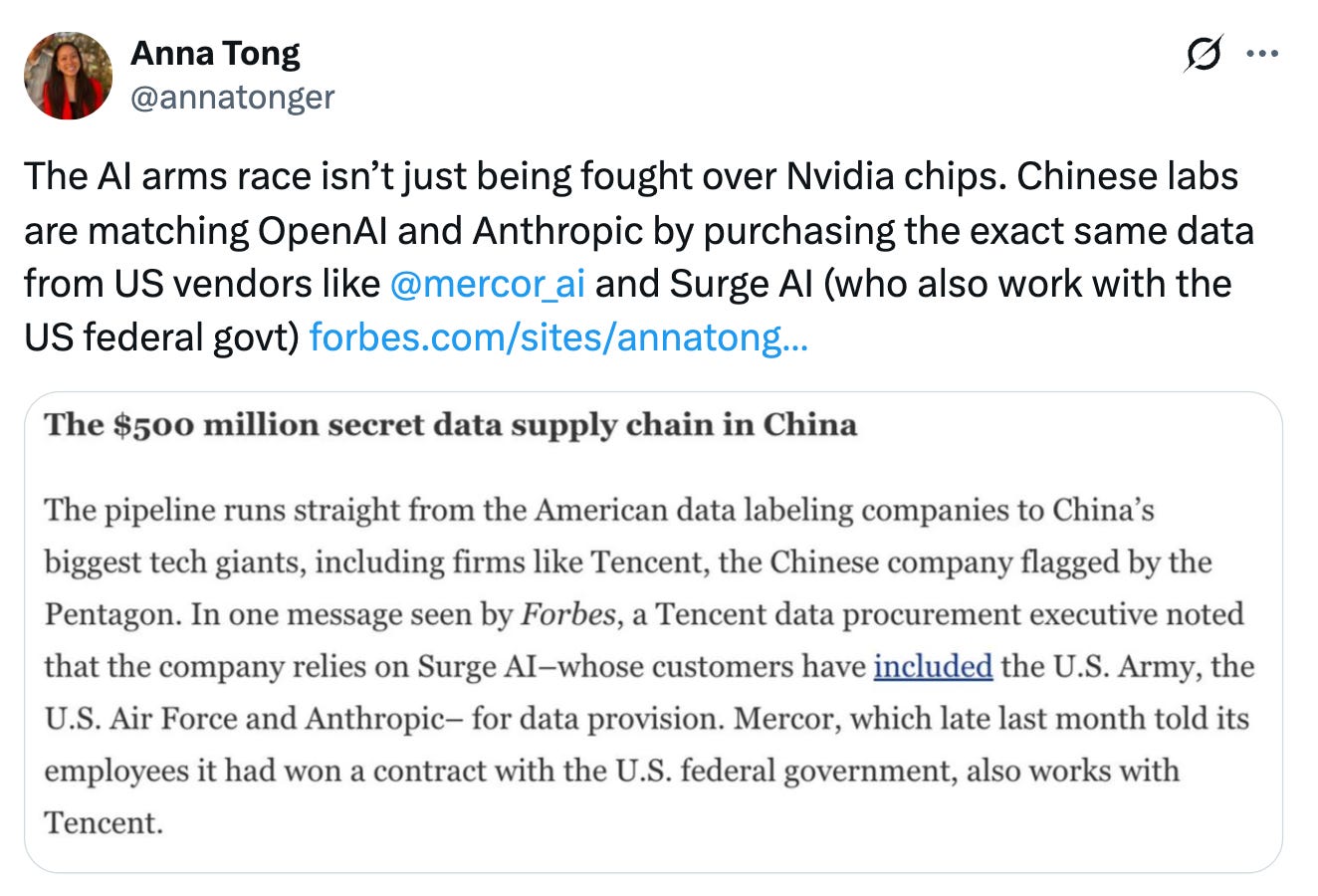
This type of “accusation” is quite interesting, because at the same time, the same Chinese AI labs are accused of “distilling” from American large language models.
As Kevin Xu very eloquently laid out in this article about why Chinese AI labs distill, distillation is mainly used as a shortcut to get high-quality training datasets. It’s a “data strategy”, as opposed to getting underlying algorithms and weights, which is impossible to distill.
Now, if distillation is not allowed, at least you will think buying data through proper channels is fine?
Turns out, it’s not fine. The logic of America today, both its government and its public opinion, appears to be that they should stop selling or giving ANYTHING that might potentially help the Chinese AI industry grow, even while Chinese open-weight models have been widely adopted in the US.
But why should we stop there? We should make it illegal for American firms to use Chinese open-weight models as well.
And it’s not just the US. We should ban all of our allies from using Chinese equipment, just as Chris McGuire, the senior fellow of the Council on Foreign Relations, proposed in response to the Reuters story that Samsung and SK Hynix are testing Chinese chip tools as a hedge against US risks.
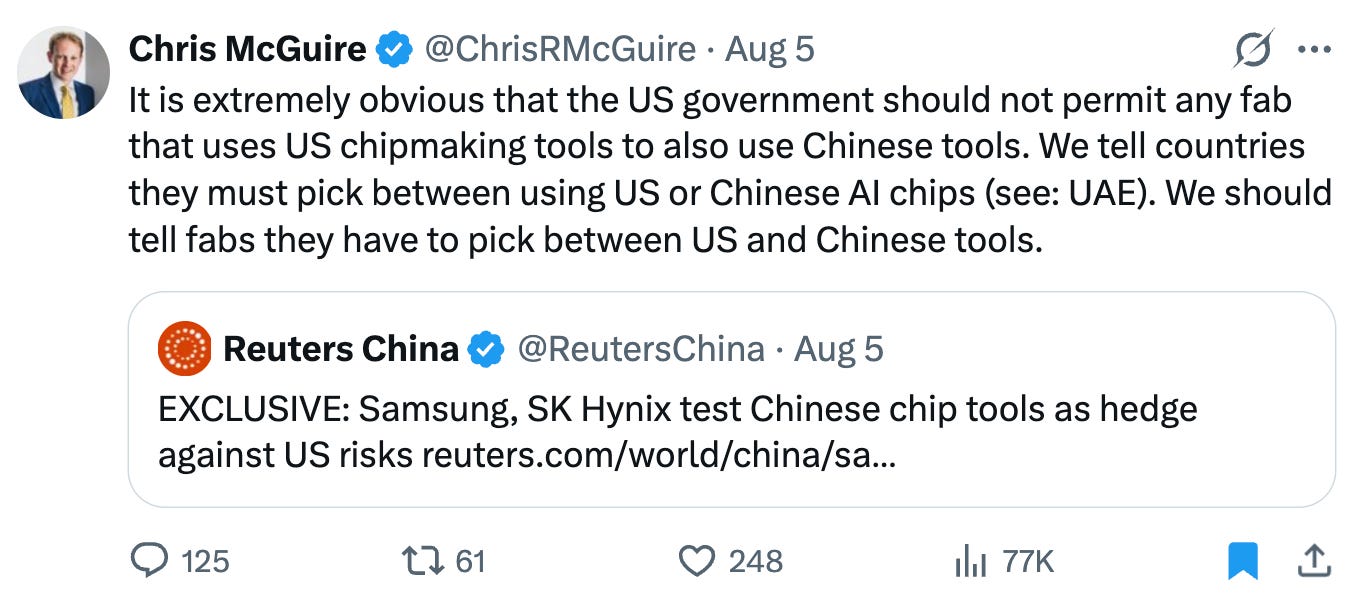
At this point, it’s difficult not to do a linear extrapolation into the future and see that at the current rate, we will be heading toward a complete breakdown of the trade relationship between the US and China. No buying, no selling. Don’t touch me!
It’s also hard not to spot a pattern here: in these episodes of trade tension between China and the US, China is always the passive one, on the receiving end. The US introduced tariffs; China responded with equal measures. The US banned chips; China banned rare earths. The US banned robots; China struck back. The US always deals the “tit”, while China responds with that “tat”.
I struggle to think of any one instance in the past few years that China struck FIRST, while the US retaliated second.
It’s also clear who is embracing openness, and who is closing up. The US AI companies don’t allow their AI to be accessed by Chinese companies, but Chinese companies are announcing open-weight models every day.
Clearly, there is a total asymmetry of self-confidence, and of paranoia, between the US and China now.
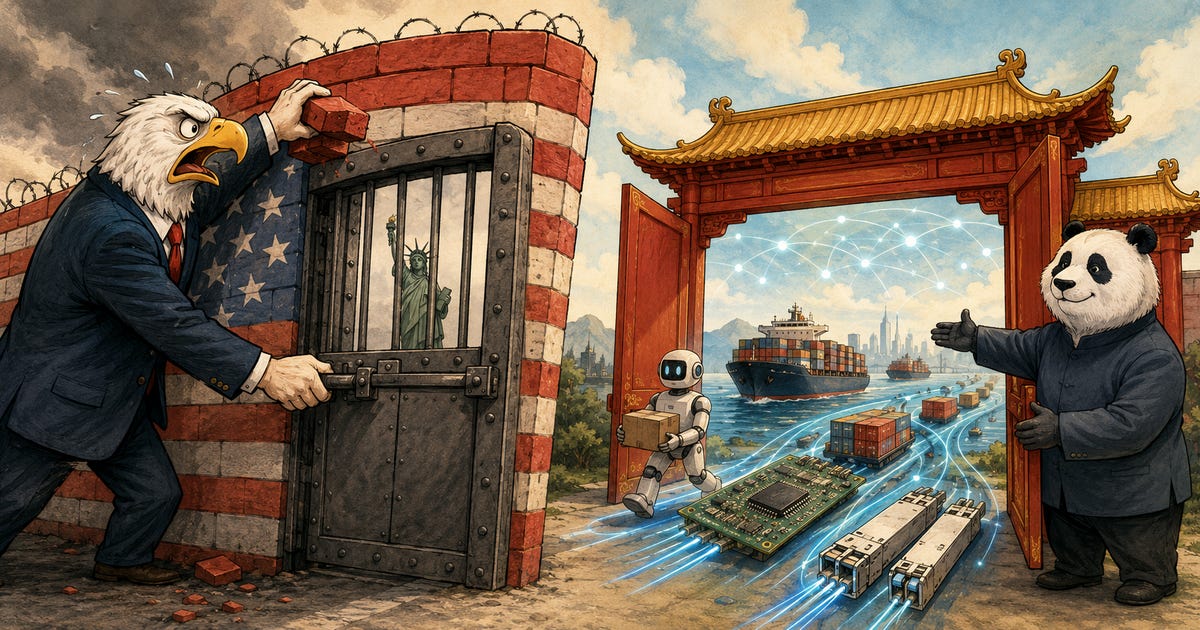
Asymmetry of Paranoia
For the US, China is an "adversary," which is just a slightly more charitable word than "enemy." In the Chinese business and technology circles I know, the language is different. The US is certainly a competitor. It is also seen as a power that is increasingly going mad. But it remains a great country from which China can learn.
There is paranoia in China’s security establishment, of course, but it has not penetrated ordinary business and technology conversations to the same extent. For instance, if you read what Liang Wenfeng said about the US, even behind closed doors, he did not sound as paranoid about the US as Dario is about China at all.
Why is today’s America so much more paranoid about China than the other way around?
Perhaps this is simply the psychology of an incumbent and a challenger. The incumbent experiences every exchange as a possible loss of advantage. The challenger experiences the same exchange as an opportunity to learn. One tries to preserve its lead by reducing contact, while the other tries to close the gap by increasing it.
But this explanation does not make the result any less ironic.
For most of the modern era, openness was central to America’s identity and its claim to superiority. Open markets, open scientific exchange, the free circulation of ideas and talent. These were evidence of American confidence. A powerful country could afford to remain open because it believed that it would gain more from exchange than it would lose.
Closed countries behaved differently. They banned foreign products, restricted information, pursued self-sufficiency and treated outside influence as a threat. Their fear of exchange was supposedly evidence of their weakness.
That is the deepest irony of this trade war. America’s opposition to China has become so total that it is gradually adopting the very characteristics it once presented as proof of the Chinese system’s inferiority, and perhaps is even on the path to surpass China in this regard.
I basically agree regarding the economy, but also China is afraid of the internet (yes I know getting a VPN is easy for the upper and educated middle classes, but the fear speaks for itself here). America is in its Qing dynasty stage but a country that throws people in jail for having the wrong religion or too much religious belief cannot really claim superiority here in any metric besides economic and manufacturing strength.
That loss of confidence and fear of being challenged successfully are key. America is in so many ways fighting itself, not China, not the world.