

In an unprecedented move, China’s National Development and Reform Commission (NDRC) has formally blocked Meta’s acquisition of the startup Manus and ordered all parties to unwind the deal, citing a foreign investment security review. Per NDRC, Meta is now required to cease using the firm’s algorithms and divest its stake, reversing the 2-billion-dollar deal first announced in December 2025.
To make sense of this whole saga, we need to first run down the key facts and timelines, and then I will proceed to answer some of the top questions.
Timeline of the Meta-Manus Acquisition
2022: The startup, originally operating as Butterfly Effect, is founded, with research and development teams based in Beijing and Wuhan.
March 2025: Manus debuted its general-purpose AI agent, capable of executing complex, multi-step tasks such as resume screening and stock analysis. The release gained massive viral attention and is compared to “DeepSeek” as a sign of China’s rapidly closing AI capability gap.
April 2025: Benchmark Capital led a $75 million funding round in the startup, valuing the company at $500 million.
May 2025: The U.S. Treasury Department launched an official inquiry into Benchmark’s investment. Regulators investigated whether the funding violates outbound investment security rules, citing concerns that the capital could accelerate sensitive AI development in a “country of concern.”
Mid-2025: To mitigate geopolitical and regulatory pressure, the company relocated its headquarters to Singapore. The founders laid off remaining staff in China, shut down local social media accounts, and rebranded to position themselves as a Singaporean enterprise, a move industry observers dubbed "Singapore-washing."
December 2025: Meta announced its acquisition of Manus for more than $2 billion, aiming to integrate the company’s autonomous agent technology.
January 2026: Chinese regulators launch a formal investigation into the deal. Authorities focus on potential violations of national laws regarding technology exports, data transfers, and foreign direct investment.
March 2026: The regulatory situation intensified. Manus co-founders were summoned to a meeting in Beijing with officials from the NDRC. They were reportedly barred from leaving the country while the investigation proceeds.
April 27, 2026: The NDRC formally blocked the acquisition.
What’s special about the Manus deal?
Under Chinese law, the acquisition of Chinese companies by foreign investors is subject to government approvals, a process similar to CFIUS in the US. If Manus were a Chinese company and were acquired by Meta (assuming CFIUS approval), the deal would need to go through the approval process in China, as with any cross-border M&A, and there wouldn’t be anything dramatic about it.
What made the Manus case unique was that it was originally a Chinese firm, but just as the product went viral, they dissolved the Chinese entity and re-established themselves as a new company in Singapore.
While they kept the same product, technology, and core team, this “Singapore-washing” move allowed them to bypass the approvals (or so they believed) that would otherwise have been required when Meta acquired them.
Fast forward to today, Beijing is basically saying that substance matters more than appearance, and that Manus cannot bypass the relevant approvals. Because they completed this deal without the necessary authorization, it must now be unwound.
It is important to note that there are no penalties or fines yet, nor is there any criminal prosecution.
So far, it is strictly business.
Why did Manus conduct “Singapore-washing” in the first place?
Manus served a mostly international market, received USD funding, and was built on US foundational models such as Claude. The US inquiry into Benchmark Capital’s investment in Manus was perhaps one of the many triggers that persuaded the team to change its identity.
They are caught between the two worlds.
How would the unwinding actually take place?
Conceptually, it’s not as hard as it sounds. If all of the 3 key parties: founders, investors, and Meta, agreed to an unwind, it can be done. The details of how to “decontaminate” Manus technology away from Meta are secondary matters.
I heard that at least some investors have already agreed to return the cash. It’s also entirely possible that Mark Zuckerberg already had buyer’s remorse since the consensus was that he was in a bit of FOMO when pulling the trigger back then. And the founders? Very likely, they were the first to fold.
Does Manus control any core technology that warrants such an unprecedented reaction from Beijing?
Manus belongs to the class of companies that are often referred to as “AI wrappers”. They do not train their own models, but through smart design and engineering decisions, they leverage model capabilities to deliver a smooth user experience.
I have been a happy Manus user for almost a year. I find that, for someone like me with no engineering background, I prefer Manus to Openclaw as my go-to AI agent for tasks like creating a simple app or conducting deep-dive research. (However, had I had access to Claude, I probably would have considered switching over.)
Overall, Manus is not DeepSeek, or Huawei, and I do not think Manus controls any core technology that Beijing would care much about.
So why is Beijing blocking the deal? Is Beijing not afraid of hurting overseas investors' sentiments and entrepreneurial spirits again?
Although Manus does not possess any core technology of national security importance, Beijing is afraid that such “washing”, if unchecked, would serve as a terrible example for others to follow, rendering China’s foreign investment regulation toothless.
A key factor that explains Beijing’s action that outside observers often missed was that Meta’s $2 billion deal was very openly touted by Manus’s founders and investors as a dizzying success story.
It was very to-the-face.
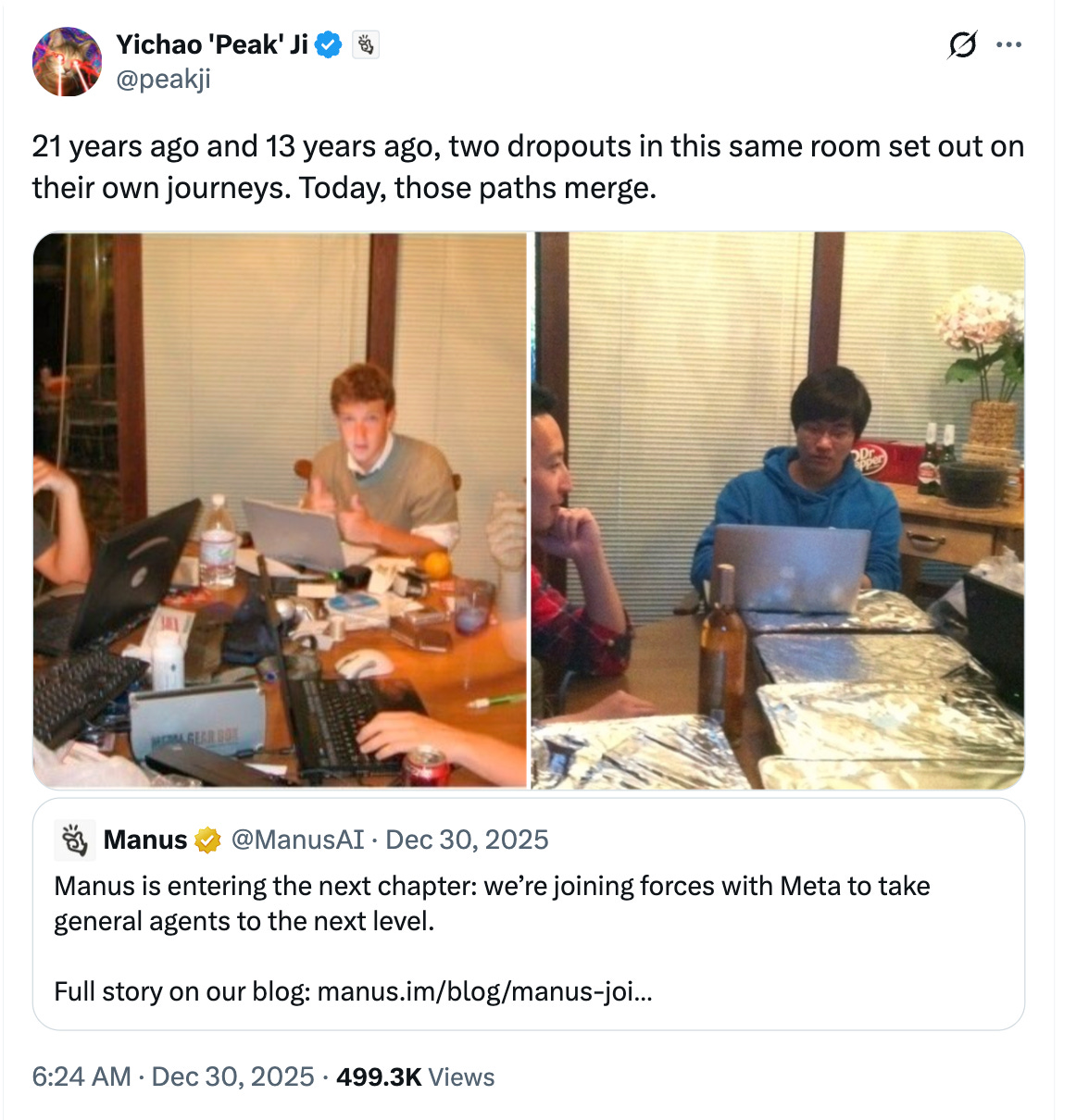
Had the Manus founders not been so overexcited about the deal and never made the $2 billion price tag public, I doubt this would ever have happened. But since it is now well known that a previously Chinese start-up achieved such huge success immediately after changing its “cover” to become a foreign company, Beijing’s hands are also tied. Allowing this to happen without any brakes will send a wrong signal to future tech entrepreneurs.
So, why were the founders and investors of Manus so giddy about the Meta deal? And also, why did the Manus founders reportedly return to China, given the possibility they would be barred from leaving?
I think the main sin of the Manus team is their naivety.
When they did Singapore-washing, they genuinely believed what they were doing was good and necessary. And when they were acquired so quickly at such a high price, they genuinely believed it was something to be celebrated. And when Beijing raised eyebrows, they genuinely believed they could explain the trouble away and chose to come back to the country and straighten things out.
Had they been conscious of the consequences, they would “Singapore-wash” or “Silicon Valley-wash” themselves from day one, as many of their peers had long ago, and they would not be where they are today.
They live in the illusion that this world is still the same globalized world when Mark Zuckerberg founded his empire.
Will this landmark episode force Chinese founders to leave and found companies overseas from Day 1?
I believe this has already happened.
My sense was that most founders who wanted to do this “Day 1 washing” had already done it. They just weren’t as outspoken as Manus about it. The remaining ones are perfectly happy with being a Chinese company. So net-net, the damage from this case to China would be limited and would be outweighed by the benefits.
The problem with Manus is that they only half-did it and thought it was not a problem. It’s the combination of this half-heartedness and the naive over-excitement I mentioned above that made Manus into a punching bag.
Most companies have already picked a side. Manus was just too late in making up their minds.