

As briefly mentioned in last week’s Briefing #66, something interesting has been happening in China’s online discourse recently. China’s censorship machine, assumed by many to move in only one ideological direction, has started to bite from both ends of the political spectrum.
On the far left, a movie review of Youth (芳华) - a fairly unremarkable 2017 film about a military performance troupe set in the 1970s and 1980s - suddenly went viral on domestic video platform Bilibili, at least for a few days.

Youth was never meant to be a grand historical statement. It’s the kind of movie you watch once, feel a vague sense of nostalgia, and then move on. This time, however, the film was taken out of the grave and radically reinterpreted. A popular Bilibili reviewer reframed it as a hidden ode to the Great Proletarian Cultural Revolution.
Not a tragedy. Not a warning. An ode.
The claim itself is almost comical. I won’t waste your time by going into details of this movie. But what I can tell is that, if anything, the movie can only be described as something to criticize and reflect on that era. Moreover, both Feng Xiaogang, the director, and Yan Geling, the author of the original novel, are commonly known as harsh critics of the Cultural Revolution.
So this claim is about as credible as arguing that The Godfather or Zootopia is secretly praising the Cultural Revolution. In fact, under the same logic, any story reflecting some elements of class difference, injustice, or social stratification can be reverse-engineered into Maoist revolutionary nostalgia.
And yet, the video worked.
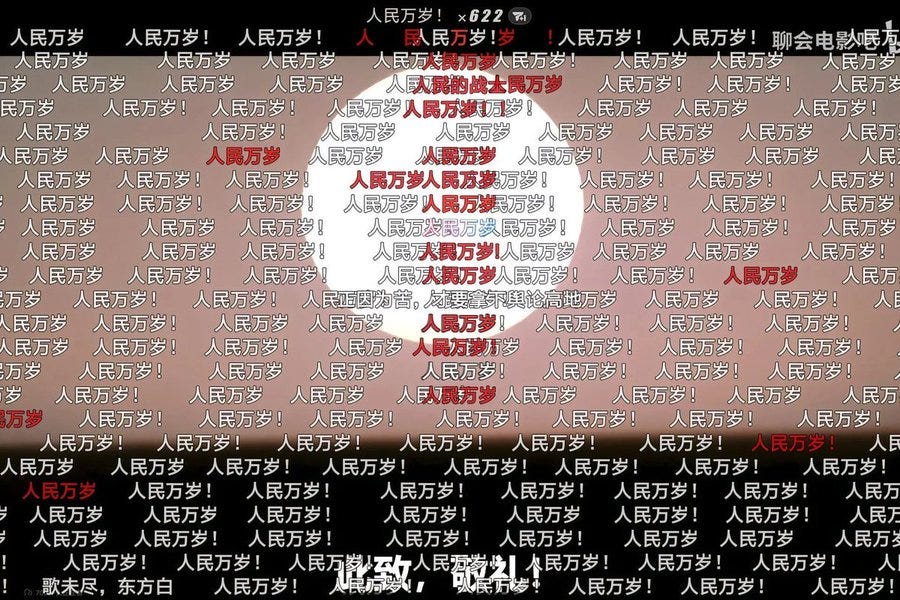
Partly because the influencer is genuinely good at storytelling, the review racked up tens of millions of views in just a few days before it was eventually taken down. On Bilibili, viewers can send so-called “bullet chats”—comments that fly across the screen as others watch the same segment. I was told this video accumulated more than 300,000 bullet chats, enough to completely drown out the actual film if you turned them on.
Many of those bullet chats repeated the same slogan: “Long live the people.”
In this worldview, the Cultural Revolution was a righteous uprising of the proletariat smashing entrenched elites. Mao was a misunderstood hero, smeared by later narratives, whose true intentions are now being rediscovered by a new generation.
This interpretation sits in direct conflict with the official Chinese position, which describes the Cultural Revolution as a catastrophic mistake—an “apocalypse” that destroyed institutions, cultural heritage, and lives. This contradiction alone made the video politically radioactive.
On the opposite end of the spectrum, another ideology, once fringe, is moving closer to the mainstream. It is often referred to as 皇汉, or Han ethnonationalism.
A focal point of this worldview is a radical re-evaluation of Qing dynasty history, summarized by what its proponents call the “1644 historical viewpoint.” The argument is stark: true Chinese civilization ended with the fall of the Ming dynasty in 1644. What followed was a Manchu conquest—an ethnic minority subjugating the Han majority. The Manchus committed atrocities, governed incompetently, and ultimately weakened China so badly that it made the Chinese nation miss the Industrial Revolution and endured more than a century of humiliation.
Had the Ming survived, the argument goes, China might have industrialized on its own and never would have had this humiliation.
Needless to say, this directly contradicts the official CPC narrative of Zhonghua minzu—a unified Chinese people composed of 56 officially recognized ethnic groups, including Han, Manchu, Mongolian, Tibetan, Uyghur, Kazakh, Miao, and others. In the official framework, Qing history is not a foreign occupation but an integral part of a continuous, multi-ethnic civilization.
The official crackdown on this was swift. One of the most popular accounts advocating the “1644 historical viewpoint” has been shut down, while the state apparatus appears to be so alarmed that it has already issued several high-profile takes attacking it. To have a sense of the severity of the official pushback, you can take a look at an article translated by Sinical China, a Substack affiliated with Xinhua.
How to make sense of this
Despite standing at opposite ideological poles, these two schools of extreme thought share several striking similarities.
Both narratives mix some elements of truth with distortion. In both cases, these elements of truth are lifted out of historical proportion and reorganized into simplistic moral frameworks.
Yes, Manchus did commit atrocities during the invasion of China Proper. But the Manchu may be the most sinicized ethnic dynasty throughout Chinese history, whose leaders spoke Mandarin and wrote in Chinese, and deeply respected the Chinese way of life. By the end of the Qing, the difference between a Manchu person and any other Chinese person was almost entirely unintelligible. Also, are we really sure that, had it been the Ming, not the Qing, who had met with the Western powers at the sunset phase of its dynastic cycle, we really could have done much better?
Moreover, what Han-nationalists always conveniently forget to mention is that had it not been for the Qing, China’s territory would not have been as large as it is today. It was the Qing Dynasty that first allowed China to effectively control Tibet, the Northeast (Manchuria), and a large part of Mongolia. And if not for the Qing, a political power hailing from China Proper would not have regained Xinjiang after 1000 years of losing it following the An Lushan Rebellion. If Manchus were not “Chinese”, what about those regions? Should we split China into pieces now if we really want to be fundamentalist about it?
As for the Cultural Revolution, yes, it did involve genuine elements of class struggle and strong anti-establishment sentiment (which many people today didn’t know about; they just knew it was “bad”). But the modern-day champions of cultural revolution once more always forget to mention that it was also, at the very core, a great power struggle of Chairman Mao against his many perceived political rivals. (It’s just that, unlike typical tyrants, he used the mass movement and chaos as opposed to guns and poisons to achieve this end.) And in the ensuing chaos, the evil of people found its way out, destroying lives, both corporeal lives and mental existence. There was no revolutionary romance about it at all.
At this point, it is also imperative to mention that both narratives also thrive in the blind spots of official narratives. Some topics—such as ethnic relations—are forced down into people’s minds in rigid, slogan-like terms, without ever being put up for debate. Others—most notably the Cultural Revolution—are acknowledged and then sealed off, with little room for sustained public discourse. As a result, even educated audiences often lack a deep, nuanced understanding of these issues.
When discourse is absent, fragments of truth become dangerously persuasive. Partial facts, stripped of context, can feel revelatory. When people know nothing about the nature of the Cultural Revolution, beyond the mere fact that it is “bad”, then anyone who reveals the anti-establishment side of it and claims it to be “good” will immediately gain immense credibility.
I also remember this vulnerability personally. When I was fifteen and first learned about Tiananmen Square, you could have told me almost anything bad about the CPC, and I would have believed it—not because I was stupid, but because silence creates an intellectual vacuum.
Finally, both movements feed on anxiety, especially among young people. Economic pressure, social immobility, and a sense of lost direction make grand explanatory narratives emotionally attractive. They don’t just interpret history; they assign blame and offer clarity. This is the same psychological terrain behind the silencing of figures like Zhang Xuefeng and Hu Chenfeng that I commented on in October.
Which brings us to the real irony: The emergence of these extreme narratives is, in large part, the by-product of the censorship regime itself.
If certain histories cannot be openly discussed, if official narratives leave no room for questioning or reinterpretation, then alternative explanations will inevitably fill the gap. Crackdowns may remove the most visible expressions, but they do not address the conditions that produced them. In fact, suppression often strengthens the sense that something important is being hidden and will inevitably resurface, leaving the official machinery in perpetual cycles of whac-a-mole.
Today, these views are still not mainstream. But history rarely turns on what people believe today. It turns on what accumulates quietly over years and decades. More importantly, the socio-economic conditions that underpin their emergence can only worsen in the foreseeable future.
If extremism grows in the shadow of silence, while no organic counter-narratives are nurtured, who would have the power and credibility to contain it if one day, for whatever reason, when that whac-a-mole machine no longer functions?
The last paragraph/question takes on added weight in the era of social media...wherein system platforms are specifically designed and operated to maximize extremist engagement. It is not a medium for intelligent discourse. Plus....humans. We're talking humans here. Humans are a problem.
Per "Youth"...I saw it in the theater when it was released. It resonates poignantly with olde people (me). It takes a bit of life experience to appreciate it. I can easily see young people giving it a yawn.
Great analysis, Robert.
However, I wonder if this 'extremism' is less about a lack of historical knowledge and more about current social frustration? If people were happy and optimistic today, they would likely watch a movie like Youth for pure entertainment.
It feels like the past has become the only 'safe' language left for people to express their unhappiness with the present. This explains why the government is so quick to censor these narratives: they aren't just protecting historical facts; they are trying to shut down the implication that life in 1644 or 1966 was somehow 'fairer' or 'better' than life in 2025. In a system where you can't criticize the present, romanticizing the past becomes a radical act of protest.